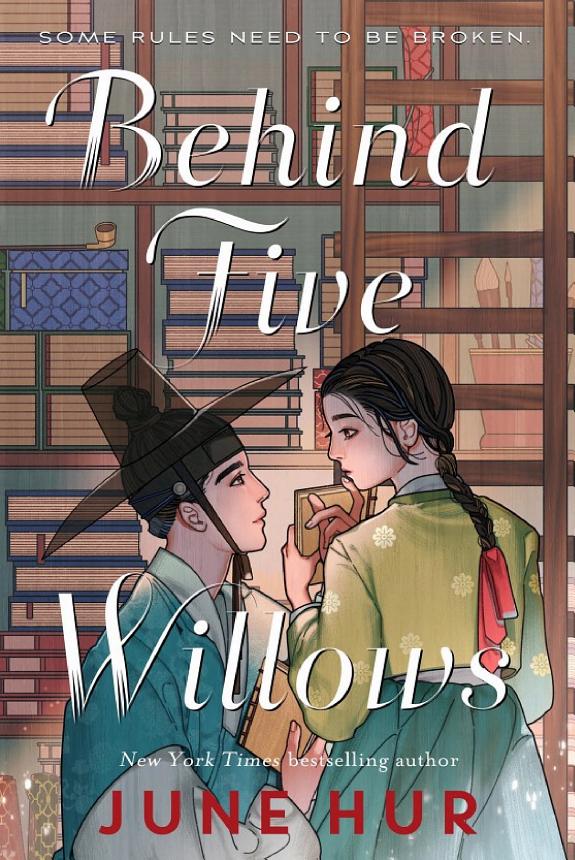
Behind Five Willows
June Hur
This charming retelling of Jane Austen’s Pride and Prejudice moves the action and romance from Regency England to the Joseon dynasty of 18th-century Korea.
Before the literary fun, a bit of history: The Joseon dynasty ruled Korea for more than 500 years. During its early centuries, it was a cultural and scientific golden age with the creation of the phonetic alphabet, movable type, the smart design of hanok homes, sundials, and celestial globes. But in 1875, the King banned the writing and reading of fiction. He simply didn’t like novels, and he had grave concerns about the negative influence of Western knowledge and Catholicism. Who knows what dangerous ideas might be hiding within the pages of a novel!
The marriage practices of the time would also raise some eyebrows now. When a king or crown prince was in need of a wife, the state issued a temporary ban preventing single young women from marrying anyone until the royal gentleman had made his selection. And, not unlike the British Regency era, there was a stigma attached to being an unmarried woman. In this neo-Confucian society, a single girl past her early twenties was a problem to be solved. Worried parents quickly married off their daughters to make them seem more respectable — or to avoid them being chosen by the king.
Author June Hur uses these historical bits — the book edicts, the marriage laws, Confucianism — to put a fresh, Eastern spin on the marriage plot of Jane Austen’s original.
It’s 1792, in Gyonam Village, just outside the gates of the historic capital. Our heroine Haewon is a second daughter, well mannered, but inquisitive. Kind-hearted, but no pushover. She loves to read novels, edict be damned, and she has a secret identity. Working under the pseudonym Magpie, she earns extra money as a scribe for an underground lending library.
Her favorite books — to read and copy — are written by Black Lotus, a mysterious author of thrilling adventure novels. Unbeknownst to Magpie, Black Lotus is really Seojun, a lord and the only son of a nobleman. He’s the city’s most eligible bachelor (with manor house of 99 rooms).
When the new marriage decree drops — be wed asap or have a spouse chosen by the state — Haewon’s very beautiful older sister Jade is in trouble. She’s been named one of the 281 spinsters in the capital; marriage is imminent. Happily, she’s soon smitten with a very nice young man who just happens to be best friends with Black Lotus — the noble, arrogant, condescending, very handsome author.
The need for chaperones being what it is, the four young people are thrown together. For a while, we know the true identities of Magpie and Black Lotus, but they do not. This makes for amusing scenes of barbed banter. When they eventually discover their true identities and shared passion for the written word, serious hijinks ensue.
The plot cleverly follows the narrative beats of Pride and Prejudice. There are a slew of Very Important Letters, and the text is sprinkled with literary Easter eggs, including a (delightful) scene lifted straight from Jane Eyre. Hur’s re-imagining feels like an alternative universe, thanks to the particulars of Korean history and social mores woven into the familiar story.
The acts of reading and writing are significant to the characters. The verbal sparring between our hero and heroine sparkles, especially when they argue about the aim of the written word: Is it meant to dictate morality — or is it an expression of emotion and the self?
A number of action-packed scenes keep the pace brisk, including a raid on a bookstore, a house of ill repute, a massive storm, frantic horseback rides, and the dramatic revelation of secrets.
Although it’s a retelling of a beloved classic, it stands on its own as historical fiction, an engaging way to learn about Koreana history — and, not for nothing, there’s kissing.
Catching up her skirt, she quickened her steps, and soon she was running, her heels striking hard across the dirt road. ‘Do not run,’ she could hear Maid Boram’s phantom voice. ‘It is unladylike to run!’ Haewon ran faster, for if she did not run, she feared she would cry from frustration.
There were too many rules a woman had to live by. Too many strings attached to her — her mind, her heart, her very soul — forever pulling and pulling at her. It was all horribly unfair… Haewon ran until her skirt was coated in dust, her chest heaving for air, needles shooting through her lungs with each breath. Her mouth felt dry and her face was flushed, but she refused to cry.
— June Hur