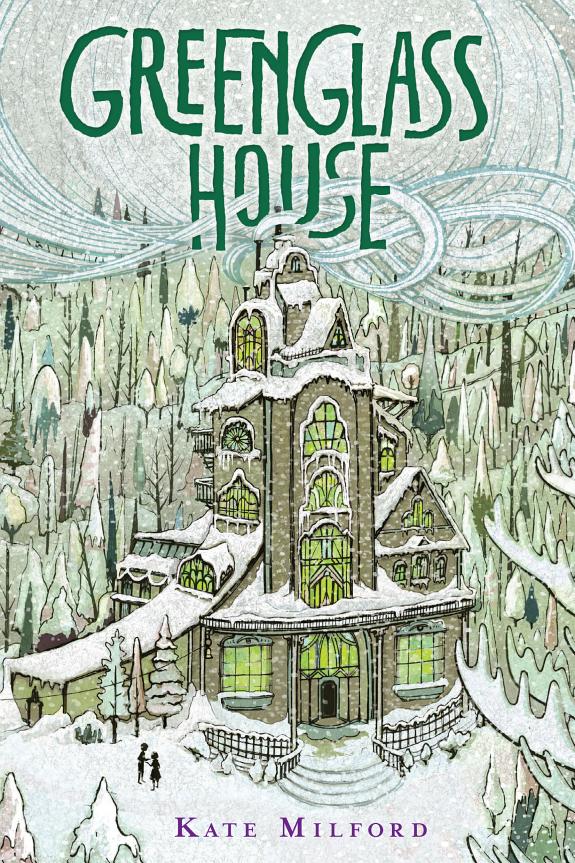
Greenglass House
Kate Milford
This book’s first line invites us right into the adventure: There is a right way to do things and a wrong way if you’re going to run a hotel in a smugglers’ town. Noted! Now, please, tell us more.
The title home is a famous smuggler’s inn, perched above a harbor town called Nagspeake. In winter, it’s usually quiet. Milo is happily anticipating a low-key holiday with his adoptive parents (who are the innkeepers). The plan is to read, snack, and enjoy the calm. 
But then the guests show up, interrupting Milo’s peace, particularly because it’s not a normal trickle of tourists, but a strange handful of people who arrive all at once, each with their own luggage, their own agenda, and their own story about why they’re there. Some are prickly, some are charming, some are obviously lying, and at least one feels like trouble the moment they walk through the door. Then, as if the house itself wants to liven things up for the holidays, objects start to go missing.
Milo investigates, aided by Meddy, the cook’s daughter: sharp, allergic to nonsense, fun to be around. They follow leads, compare notes, and use the logic and structure of Milo’s favorite role-playing game to chase clues and “run” the mystery like an adventure module. That element is handled with real affection and demonstrates two important points: First, imaginative play is a solid tool for making sense of the world. And second, pretending to be someone else might be useful for exploring the limits of what you can do.
Greenglass House is technically a book for younger readers. The main character, Milo Pine, is twelve. But it’s one of those (great) YA-leaning mysteries that has enough atmosphere, craft, and emotional intelligence to keep an adult happy on the couch. Cozy without being cutesy, clever without being smug, it has old-fashioned pleasure of a big creaky house full of secrets. If you like mysteries where the author plays fair — planting clues, letting you form theories, and then making you gasp anyway — this delivers.
It also has things to say about belonging and identity. Milo is adopted, and the book doesn’t treat that as an accessory detail, ‘Oh, yeah, the kid’s an orphan!’ It’s an integral part of how Milo experiences the world. There’s an honesty to the way Milo thinks about ancestry and belonging, and that’s not accidental. In Milford’s Author’s Note, she explains she began writing the book during her family’s international adoption process. She had been reading and thinking about culture, heritage, and what it means to build a family across distance and history. That context adds a depth to this story: The house has a past; the town has a past; the objects have past owners; and Milo is trying to understand how his own past fits into all of that.
The holiday vibes in this book are fantastic — snowy inn + smugglers + board games + stained glass + secret histories + cinnamon + danger — the particular hush of an inn in the off-season, and the feeling that the world has narrowed down to lamplight, snow, and whoever happens to be in the house with you. So, yes, it’s a Christmas book. It’s also a mystery with a strong, emotional end, a warm story about family — the kind of ‘young reader’ novel that reminds you, very convincingly, that a well-crafted story doesn’t care how old you are. It just wants you to come inside, take off your boots, and follow the trail of clues down the hall.
Milo Pine did not run a smugglers’ hotel, but his parents did. It was an inn, actually; a huge, ramshackle manor house that looked as if it had been cobbled together from discarded pieces of a dozen mismatched mansions collected from a dozen different cities. It was called Greenglass House, and it sat on the side of a hill overlooking an inlet of harbors, a little district built half on the shore and half on the piers that jutted out into the river Skidwrack like the teeth of a comb. It was a long climb up to the inn from the waterfront by foot, or an only slightly shorter trip by the cable railway that led from the inn’s private dock up the steep slope of Whilforber Hill. And of course the inn wasn’t only for smugglers, but that was who turned up most often, so that was how Milo thought of it.
— Kate Milford