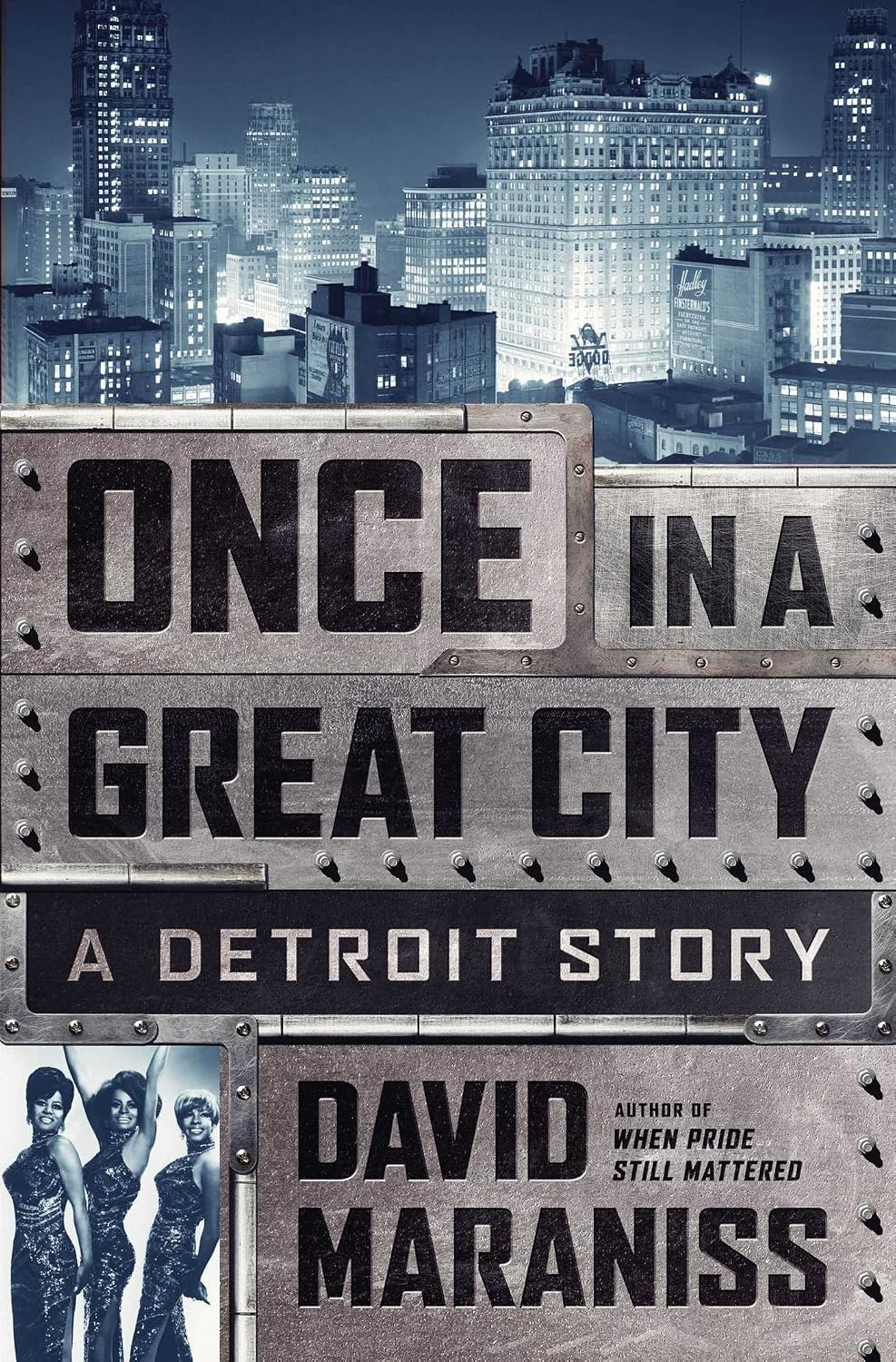
Once in a Great City
A Detroit Story
David Maraniss
This is a riveting biography of Detroit — a close read on the city from the fall of 1962 into the spring of 1964 when Detroit was peaking and collapsing at the same time.
Was there ever a more noir city than Detroit in 1963? Sure, Chicago’s right there. There’s LA and New York. You could go international with Shanghai or Hong Kong. But Detroit has got to be in the mix. In 1963, it had the top of the US auto industry, run by Henry Ford II — locals called him ‘the Deuce.’ It had the mob operating in plain sight. The police commissioner, a guy named George Edwards, kept a three-ring binder in his office labeled ‘MAFIA: Members, Relatives, Associates, Suspects.’ He also secretly wrote a letter to Robert Kennedy — Attorney General at the time — that said, ‘only open this if I turn up dead.’ Jimmy Hoffa was still walking around, and a mob party bus — ‘painted blue and silver, the colors of the football Lions’ — was equipped with a well-stocked bar and bunk beds and was routinely trailed by the vice squad. Meanwhile, Motown was about to have its biggest year yet, on the strength of twelve-year-old Stevie Wonder’s live recording of ‘Fingertips,’ about to hit number one. Martin Luther King, Jr., gave an early run-through of ‘I Have a Dream’ in Detroit, two months before the one everybody remembers. And Aretha Franklin was still singing in her father’s church. There’s a lot of stark light and dark shadow in Detroit in 1963.
The book opens with parallel action, and the first half is a symbol of exactly what Detroit thought it was. On November 9th, 1962, close to the Ford plant, was a building they called a showroom: the Ford Rotunda. The word ‘showroom’ doesn’t really do it justice. The size of a small stadium, The Ford Rotunda was an amusement park for cars. It had displays called ‘The Hall of Science’ and ‘The City of Tomorrow,’ as well as an indoor track for test drives that stretched 3/4 of a mil. There were reproductions of what Ford called ‘The Roads of the World,’ where you could drive down a replica of the Apian Way or the Oregon Trail. For a time in the 1950s, the Rotunda was one of the top tourist attraction in the country. Ford’s own PR people claimed it out-drew Yellowstone. On that November afternoon, workmen were on the roof getting it ready for the holidays. But within an hour, a propane heater and some sealant set the pride of the American auto industry aflame.
The same afternoon, a few miles away, Commissioner Edwards sent more than a hundred officers with fire axes into the Gotham Hotel. The Gotham, in Maraniss’ own words, was ‘the cultural and social epicenter of black Detroit.’ John White, a self-made businessman from Ohio, bought it in 1943, and for the next two decades it was where Black Detroit’s elite gathered, and where half of Black entertainment America stayed when they came through town — names like Ellington, Fitzgerald, Basie, Holiday. B.B. King was married there in room 609. Joe Louis, the Brown Bomber, one of the greatest fighters of all time, was a breakfast regular. His standard order at the hotel’s Ebony Room? Five scrambled eggs with ketchup and a bone-in steak. When Martin Luther King, Jr., stayed there in 1959, the owner, John White, was moved enough to put a copy of King’s book in every guest room, right next to the Bible.
The Gotham was also ‘long known to local cops and feds as the iron fortress of the numbers racket in Detroit.’ Commissioner Edwards had been a little obsessed with it. The raid and the demolition that followed were the first steps in wiping out Black neighborhoods in the name of ‘progress.’
That’s the outline of the whole book. Five storylines — Motown, the auto industry, labor, civil rights, city hall — all colliding into each other in triumph and tragedy.
David Maraniss is a Pulitzer Prize winner: He won in 1993 for his reporting on Bill Clinton, and was part of a Washington Post team that won again in 2008. He’s an associate editor at the paper today. A Detroit native, he said the spark for this book was watching a 2011 Chrysler Super Bowl commercial and finding himself surprising choked-up by Eminem’s ‘Imported from Detroit’ ad.
He pays tribute to the city with this reportage on eighteen months, decades ago, when Detroit was building its own legend while also losing its foundation.
The chronology here covers eighteen months, from the fall of 1962 to the spring of 1964. Cars were selling at a record pace. Motown was rocking. Labor was strong. People were marching for freedom. The president was calling Detroit a ‘herald of hope.’ It was a time of uncommon possibility and freedom when Detroit created wondrous and lasting things. But life can be luminescent when it is most vulnerable. There was a precarious balance during those crucial months between composition and decomposition, what the world gained and what a great city lost. Even then, some part of Detroit was dying, and that is where the story begins.
— David Maraniss