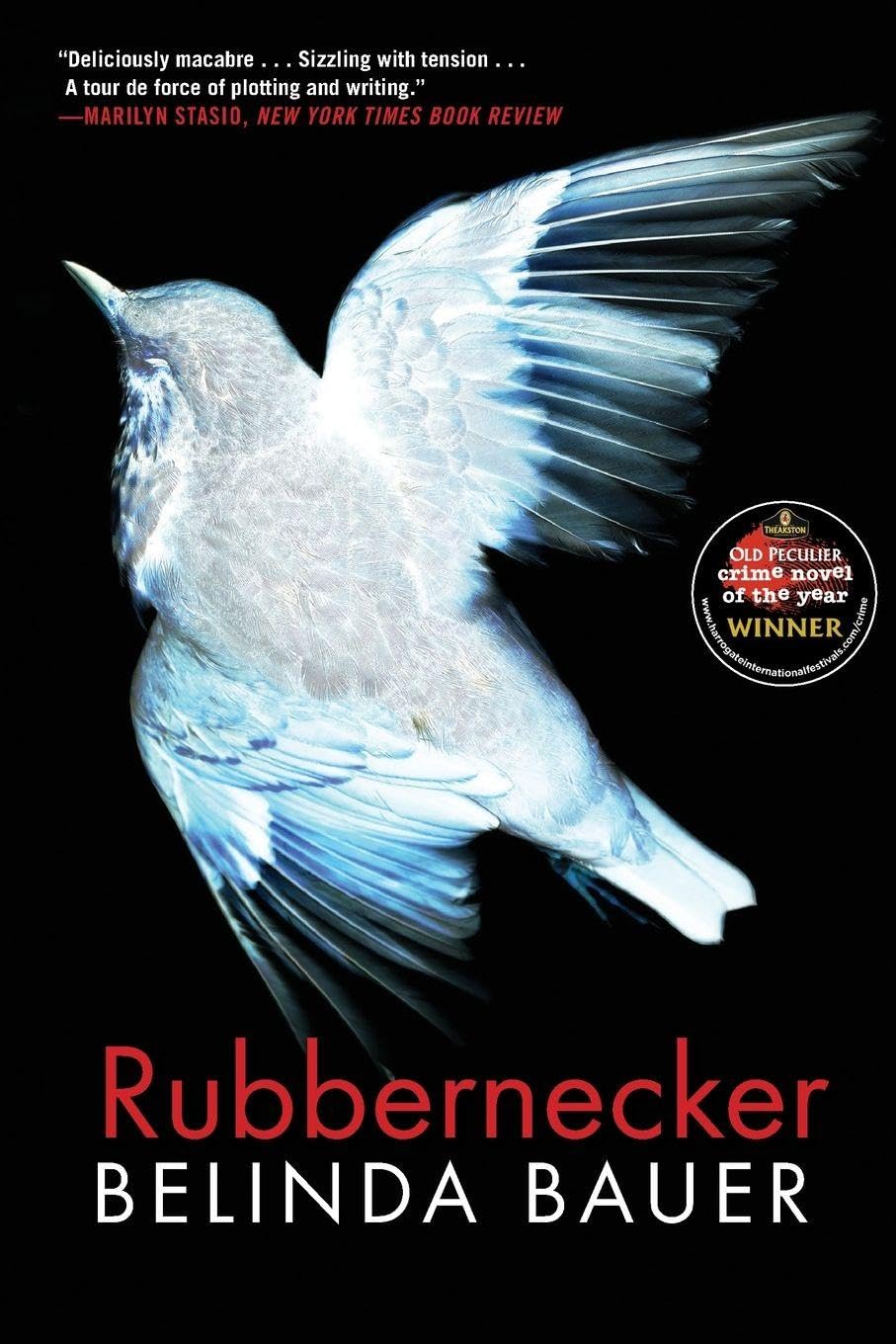
Rubbernecker
Belinda Bauer
This mystery novel — from Booker prize nominated author Belinda Bauer — one of those books where the pages just got rattling past. It’s a crime novel, so you know a body is coming, but Bauer makes you wait for it, and the story she unspools is relentlessly propulsive.
The two main characters and their unique situations are introduced in the first paragraph. There’s Sam, victim of a horrific car accident in Cardiff. Insult to injury: the ‘Pina Colada Song’ is playing on his radio when his car plunges into the River Tiff. That should be the end of him. But as a reader, you know it’s not: He is narrating this tale in the first person, past tense. This man is alive somehow.
The narrative leaves him to pick up the thread of Patrick, an 18-year-old university student with Asperger Syndrome. He’s hyperlogical, very literal, and permanently baffled by the social shortcuts the rest of us take for granted. He’s the kid who lines up blue gloves in perfect rows, eats food in alphabetical order, and gets into trouble by answering questions honestly instead of politely. He’s in a car with his mum, driving over the bridge just after Sam’s crash, so he sees the aftermath, not the crash itself. Although he bolts out of the car to gawk at the tragedy, for at a chunk of the book, there’s no hint of how these two stories will eventually intersect.
Bauer plays a bit fast and loose with time in Rubbernecker, shifting the camera and doling out short, vivid scenes, tossing narration between first-person (car-crash victim Sam) and third (everyone else). By the fourth chapter, Sam is in a coma ward, describing the sensations of being trapped in his own body, hearing and thinking but unable to respond. And Patrick has moved to the dissecting room of an anatomy course, assigned cadaver Number 19, along with a group of squeamish undergrads.
Patrick’s superpower and his burden is the ability to notice – and what he sees inside the body does not line up with the official cause of death. It becomes a diverting puzzle for Patrick — and a compelling question for the reader: Is Number 19 Sam? How can that be?
The route to these questions is revealed in the form of a third crucial plot thread: a weary Welsh detective. Slowly, deliberately, those three strands — the dissecting room, the coma ward, the police investigation — begin to braid together. You come for the mystery; you stay because you care about these people.
Patrick is the heart of the book. Bauer doesn’t use his diagnosis as a cute quirk; it’s the lens of the whole story. His autism is the reason he spots what other people miss, and it’s the reason they dismiss him. Reviewers, including autistic readers, have praised how she handles this: the hyperfocus, the social misfires, the sensory overload, without turning Patrick into a joke or a saint.
Bauer also knows Cardiff. She lived and worked there, first as journalism student and later as a court reporter. She make the city tangible through the details: its scale, the way rugby seeps into eveningns, the texture of the hospital corridors and the university life.
This mystery hits the sweet spot between ‘page-turning crime novel’ and ‘quietly humane character study.’ It’s twisty without being showy; funny in that dark hospital way; and an astute examination of what we owe people who can’t speak for themselves.
Patrick entered a large space filled with dead people and thought of an art gallery.
The Cardiff University dissection room was brighter, whiter, lighter than he had ever imagined; films like Flatliners and Frankenstein had apparently misled him. This was more a hangar than a lab, white and airy under a lofty ceiling filled with skylights, but with no windows in the walls. There were no views out on to the tree-lined bustle of Park Place, and definitely no views in.
— Belinda Bauer