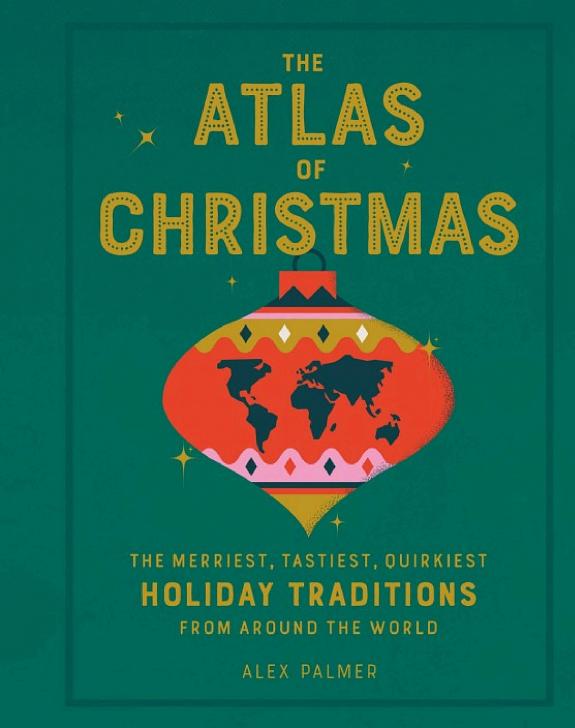
The Atlas of Christmas
The Merriest, Tastiest, Quirkiest Holiday Traditions from Around the World
Alex Palmer
This little book — 250 pages in a charming, palm-sized package — is a romp, inviting you to step through tiny cultural doorways, one country at a time, to celebrate Christmas.
Palmer opens with the powerful idea that makes this book what it is: Christmas is the ultimate shape-shifter holiday. It travels and borrows and adapts, folding into local history, weather, politics, food, and folklore until you can barely recognize the original outline. To be clear, that’s not a problem, it’s the point. Christmas has had more adaptions than Scrooge.
Which means, if you decide to take Christmas into your own hands, you’re not ruining anything. You’re participating in an ancient tradition.
Divided into sections — Celebrations Around the World, Christmas Characters, Fun and Feasts — this book is basically a little museum. Your tour stars with some warm-and-cozy staples like German Christmas markets and Las Posadas in Mexico, which is all about hospitality, acceptance, and community.
But pretty quickly we’re off to traditions that make you say, I’m sorry, what? Take, for example, the Czech Republic’s Golden Pig. That tradition says if you fast on Christmas Eve — and really commit to it — a golden pig appear to you, and that would be a sign of upcoming good fortune.
A few hundred miles away, Catalonia in Spain has the Tió de Nadal, a Christmas log that, somehow, poops candy. Beginning around December 8, families bring home a hollow log decorated with a goofy face and a little red hat. In the old days you might’ve cut your own; now most people just buy one. The log is tucked under a blanetk to ‘keep it warm,’ and every night, it’s fed bits of food by the kiddos. Mysteriously, those scraps of food are gone by morning. Then on Christmas Eve, the kids beat the log with sticks while singing a traditional song, the lyrics of which are, loosely translated, ‘If you don’t poop, I’m going to hit you with a stick… poop, log.’ When they lift the blanket — Christmas miracle! — they find a pile of treats: nuts, sweets, nougat, and small toys.
The Christmas Characters section highlights how different cultures have taken the same holiday and made very different casting decisions. Russia has Grandfather Fros and his sidekick granddaughter called Snow Maiden. Italy has La Befana, a gift-giving witch on a broomstick. In the Basque Country, families await the arrival of a giant named Olentzero.
Other cultures seem a lot more interested in Christmas bad guys; there are enough Christmas demons to fill a bar. There’s Krampus, of course, the half-goat, half-demon with horns and a long forked tongue. Some of these figures have roots that stretch back to before Christianity — which means there’s a theory Santa is a reaction to Krampus, not the other way around.
The highlight of the book is the Fun and Feasts section because that’s where it turns into pure sensory travel. Finland gives us himmeli: delicate straw mobiles hung from the ceiling. Geometric and elegant, they resemble modern sculpture, but have been tied for centuries to agricultural hopes for a good crop. Ukraine has pavuchky, small sparkling spiders on the Christmas tree that feel both eerie and beautiful. Georgia has the chichilaki — a shaggy little Christmas ‘tree’ made from shaved branches — that’s burned after the holiday season as a ceremonial release of the year’s troubles.
And then there’s the food! There are twelve-dish Christmas Eve suppers across parts of Eastern and Central Europe. Japan’s KFC-for-Christmas, which sounds like a prank until you realize it’s real. Jollof rice as a West African staple. French Yule log cake. Scandinavian mulled wine. Christmas has a table that stretches longer and wider than you might expect.
This is not a heavy scholarly tome, but it is well-researched with a robust resources section at the book. It’s a fun book you can trust. A warm, weird global holiday sampler platter, The Atlas of Christmas is a reminder that everywhere has great stories and people have been inventing and reinventing joy for eons.
The characters of Greek folklore may not be as familiar as the gods and heroes of ancient Greek mythology, but they have plenty of fascinating stories of their own. One prominent example: the Christmas-loving goblins known as kallikantzaroi. As the legend goes, the world and the heavens are both supported by a colossal tree with its roots penetrating down into the underworld. All year, kallikantzaroi are hard at work attempting to saw through the trunk of the World Tree and make all of it collapse. However, just as they are about to succeed in severing it, Christmas arrives, and the goblins are allowed to pop up aboveground into the mortal world (in a number of pagan traditions, the boundary between the physical and spiritual worlds was believed to open, or be at its weakest, during winter solstice).
Here, during the Twelve Days of Christmas, they are said to have so much fun playing pranks on humans that they forget all about the tree. When the Christmas celebration is over, marked by the Blessing of the Water during Epiphany, they are forced back down into the underworld. When they get there, they realize that the joyful celebrations have in fact healed the World Tree and their work must begin again. The rascals are forced to start over for another year, and they will not be seen again until the next December.
— Alex Palmer