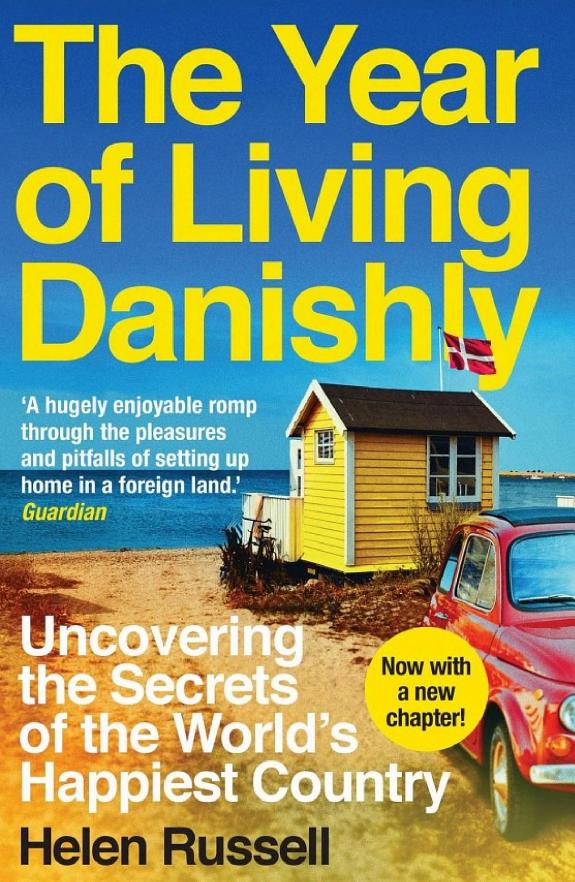
The Year of Living Danishly
Uncovering the Secrets of the World's Happiest Country
Helen Russell
British author Helen Russell has written a very funny, fish-out-of-water memoir about that time she followed her husband to rural Jutland — the quiet, flat, wind-scraped western half of Denmark — so he could accept a job at the world headquarters of Lego.
Thirty-three and working as a journalist at a glossy London magazine, Helen found herself writing ‘how to have it all’ articles while really not having it all. She and her husband had been trying to have a child, and after two years, they’re both running on fumes. One day, out of nowhere, a recruiter emails: Lego, it turns out, is looking for someone with her husband’s very particular set of skills.
Denmark is consistently ranked the happiest country on earth. She thinks, Why not? And gives herself a year to learn why the Danes are demonstrably happy.
Each chapter of the book covers a month of that year, and each is organized around a theme: Hygge & Home, Forgetting the 9-to-5, Traditions & Getting Told Off. In that last one, she is gently but firmly chastised by two bearded neighbors who have been going through her recycling bin. Not because she failed to recycle, but because she put things in the wrong bin. Things need to be done right in Denmark.
The result of her experiential investigation is part travelogue, part sociological experiment, part comedy of errors, and part personal coming-of-age story.
What she finds — and this is what makes the book worth reading beyond the jokes — is that Danish happiness is not what she expected. It’s not warmth. Danes, she discovers with some alarm, are not particularly warm or welcoming. They’re blunt, they hibernate all winter; if you’re new to town, they will more or less ignore you until spring. But they are deeply, structurally content in a way that feels unfair the more you learn about it. The welfare system that covers education and healthcare means the baseline anxiety that most of us carry just isn’t there.
Imagine not having to worry so much about education, employment, healthcare, or the costs of getting old. Imagine living in a society where people trust their neighbors. Small shifts in the baseline; enormous repercussions through the whole system.
In the book, Russell talks to an official who tells her that 70-percent of Danes say most people can be trusted. Russell writes, ‘I didn’t trust 70 percent of my extended family.’ People leave their baby prams unattended outside cafes. Bikes are parked unlocked. The Danes have a defense budget so small they can’t defend themselves — but their relationships with neighboring countries are so good, the Danes don’t believe they’ll ever need to.
Nobody competes to stay late at the office. Her husband has colleagues who clear their desks by 3:00 p.m. to pick up their kids from school. Every Friday someone bakes rolls for the office, and they all eat together. There is a Lego company band. And nobody rolls their eyes at the Lego company band. They do a song about Key Performance Indicators set to the tune of Mamma Mia, and everybody’s into it.
The Danes were the first country in the world to have a ministry of the environment. It was established in 1971. Russell writes: ‘At a time when most countries are reneging on their environmental promises, Danes are setting themselves tougher and tougher targets, and they’re on course to meet them.’
Yes, Danes pay the highest taxes in the developed world, and they wouldn’t have it any other way. Because they trust where the money is going. From a researcher quoted in the book: ‘Life’s so much easier when you can trust people.’
And then there’s hygge — the untranslatable Danish concept of coziness and togetherness that, by 2015, was just starting to reach the rest of the world through trend pieces and scented-candle marketing. Helen gets there first, and gets it right: Hygge isn’t a design aesthetic. It’s a practice — the specific feeling of being warm inside while it’s cold outside, in good company, with nowhere you need to be. Danes are committed to it. The winter darkness becomes bearable because you build a life that accounts for it.
Eventually, the personal story catches up with the cultural investigation. Something shifts. Denmark, it turns out, may be exactly where Helen and her husband need to be.
Russell went on to write several more books exploring happiness and place — including The Atlas of Happiness and How To Be Sad. She also wrote a guide to childcare called, How to Raise a Viking. That’s maybe a bit of a spoiler for this book.
The Year of Living Danishly is for anyone who has ever looked at their life and thought, There has to be a better setup than this. It’s funny. It’s honest. And it will likely make you a big fan of Denmark.
It’s not just Prius drivers, hemp-fans and hipsters who are passionate about the environment in Denmark. Being eco-friendly here is seen as a basic duty and something you do to be a part of Danish society. Inspired by the fervour of my neighbours, I go on a fact-finding mission and discover that Denmark was the first country in the world to establish an official environment ministry, back in 1971. Today, the Danish clean power industry is one of the most competitive in the world and the country gets 30 per cent of its electricity from wind. In 2013, Denmark won the World Wildlife Fund’s most prestigious award, Gift to the Earth, for inspiring leadership with the world’s most ambitious renewable energy and climate targets. It has also been voted the most climate-friendly country by the United Nations’ Climate Change Performance Index for the past two years. The Danish government aims to reduce CO2 emissions by 40 per cent by 2020 and the environment ministry has a collective goal for a ‘Denmark without waste’ by 2050 – when they hope that everything will be reused or recycled. At a time when most countries are reneging on their environmental promises, Danes are setting themselves tougher and tougher targets, and they’re on course to meet them.
— Helen Russell