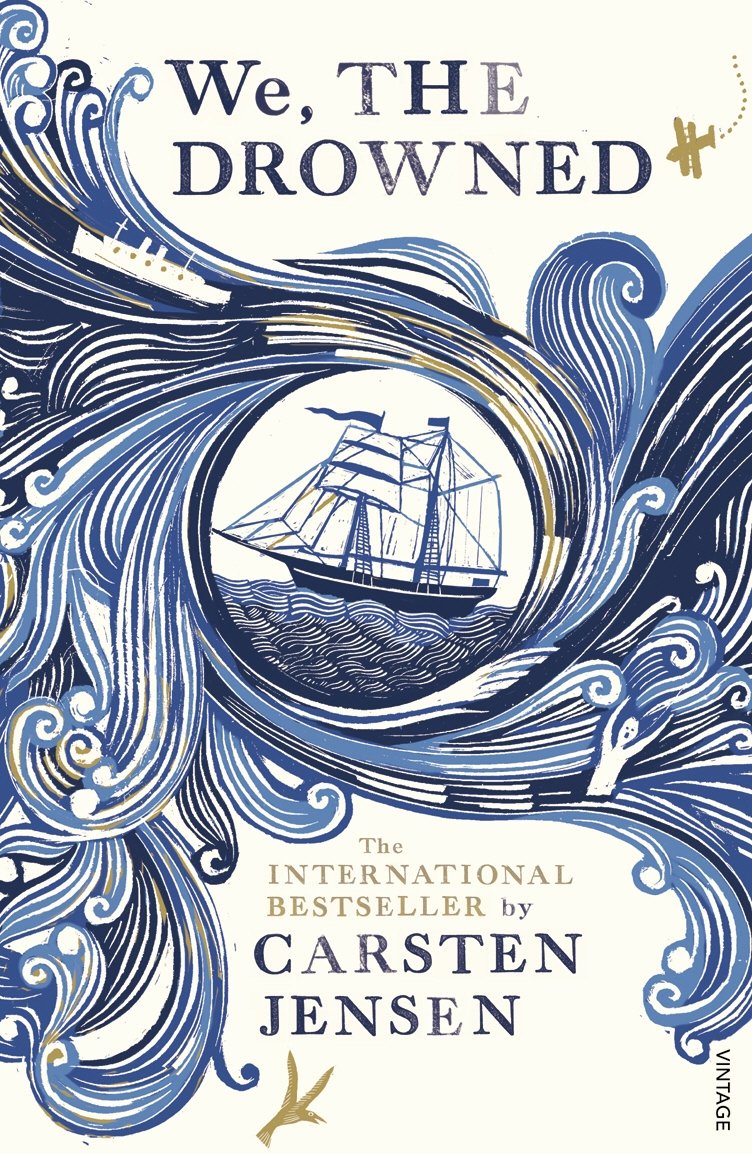
We, the Drowned
Carsten Jensen
This book, this glorious adventure, is a story about a small sailing town across time. It’s a novel about the birth of modern Denmark. About gender, and family, and the way generations inherit each other’s joys and troubles.
It’s like hearing stories from your grandfather and wondering how much of it is true, and then realizing that it doesn’t really matter. Emotionally, it’s all true.
The book centers on Marstal — a small sailing town on a Danish island, in the south of the country, not far from the German border. It opens in the mid 1800s, when almost every family has a man at sea. It’s a place where the women run the town while the harbor slowly drains of ships. A lot of men don’t come home; a lot of women and children miss them.
Early in the book, the focus turns to one of the wives. Her husband has been gone almost three years; he was supposed to be back in a few months. So one morning, the other women crowd into her parlor. They sit around her dining table with coffee, and they quietly, formally accept her as a widow. They assess what she’s going to need. They praise the lost man. The oldest woman holds her while she cries. And then, ‘they stayed until she was all cried out.’
While that gorgeous moment is a heartbreaker, this book is not a big bummer — although it does respect its darker notes. It’s an epic. A proper epic: a multi-generational saga that spans almost a hundred years, from the naval wars of 1848 all the way to the liberation of Denmark in May 1945.
We follow three generations of men from Marstal across almost every ocean on Earth. There’s Laurids, who survives a naval battle by landing, inexplicably, on the mainsail of his own exploding warship. He comes home not quite the same man who left. There’s Albert Madsen — Laurids’ son — who spends years in the Pacific searching for his missing father and returns to Marstal bearing something under his arm that… you need to read it to learn about that. And there’s Knud Erik — the final generation — who grows up to captain a merchant ship through the Atlantic convoys of the Second World War.
These men sail to the Pacific, the Congo, Australia, the American coasts. The geography is vast. The history is meticulous; Jensen spent years in the archives of Marstal’s Maritime Museum. And all of it is rooted in this one cold, specific, real Danish place, where the author grew up.
We, the Drowned is narrated in the first person plural. We. The town of Marstal speaks. ‘We went to war.’ ‘We watched from the harbor.’ ‘We didn’t ask enough questions.’ It’s the collective voice of an entire community, looking back. The effect is strange and effective — we’re inside the town’s memory. The author shifts the focus often: sometimes ‘we’ are the boys together; sometimes the whole town, watching from the wharf; sometimes the widows waiting for news. It never quite settles, and it works.
Then, near the end, the ‘we’ shifts one more time. The title tells you. We, the Drowned, the dead, have been speaking all along — the lost men from every generation, from every ship that went down. It pays off in a final scene you likely will not see coming. Best not to describe too much here except to say: It ends with a dance, and the whole book is in it.
Carsten Jensen is a Danish journalist, travel writer, and novelist. We, the Drowned was published in Danish in 2006, became a major bestseller in Denmark, and has been translated into more than 20 languages. The translation by Charlotte Barslund and Emma Ryder reads like it was written in English.
This novel will stay with you long after you turn the last page — a story that unwraps across generations, rings the magical-realism bell while also talking about real history, and hits that tragi-comic note just right.
We weren’t entirely sure which German we were supposed to be shooting. It surely couldn’t be old Ilse with the crooked hip who sold us our beloved schnapps when we moored our boats at Eckernförde Harbor. Nor Eckhart, the grain trader: we’d struck many a fine bargain with him. Then there was Hansen, the innkeeper at Der Rote Hahn. What could be more Danish than the name Hansen? And we’d never seen him anywhere near a gun. None of them could be the German; that much we understood. But the king knew who the German was. As did the captain, who had been cheering with such bravado.
We approached the fjord. The enemy batteries on the coast started to thunder, but we were outside their range and they soon grew quiet. We were given schnapps rather than the usual tea. At nine o’clock came the beating of the tattoo; it was time to turn in. Seven hours later we were roused from our slumbers. It was Maundy Thursday, April 5, 1849. Again we got schnapps rather than tea, and a barrel of beer awaited us on the deck. We could drink as much as we wanted, so morale was high by the time we raised the anchor and headed into the fjord.
We had no complaints about the victuals on board His Majesty’s ships. Food had been scarce when we’d had to supply it for ourselves. They said you’d never see a seagull in the wake of a Marstal ship, and that was true enough: we never wasted a crumb.
— Carsten Jensen