Every Friday, we celebrate the weekend — and all the reading and relaxing and daydreaming time ahead — with Melissa's favorite book- and travel-related links of the week. Why work when you can read fun stuff?!
This post is part of our Endnotes series.
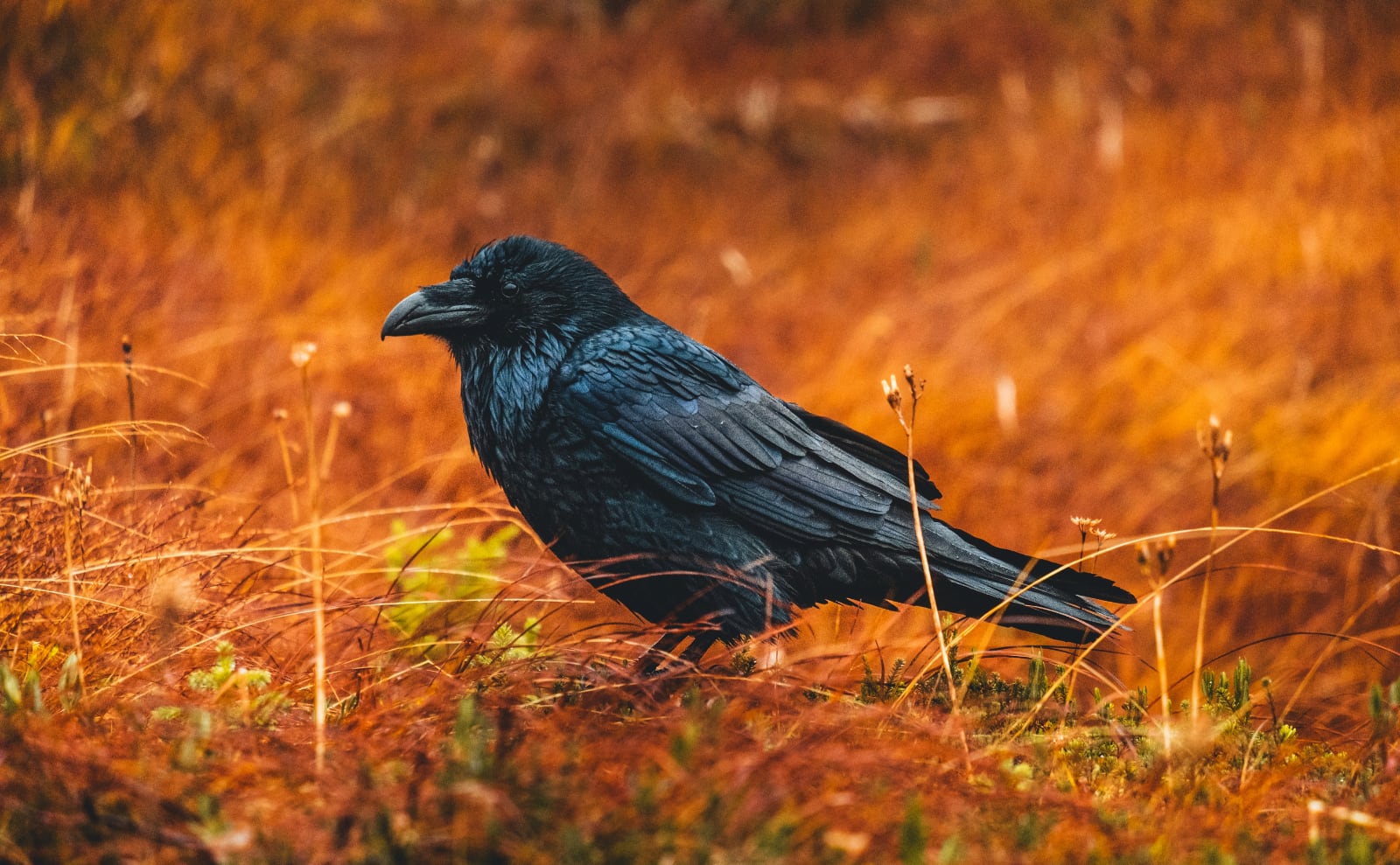
The raven — majestic, intimidating, intelligent, playful, and almost human in its ability to grieve — has lived alongside people for more than 30,000 years. In Norse mythology, two ravens named Huginn (Thought) and Muninn (Memory) are Odin’s companions — and in Native American cultures, the raven often represents transformation and is sometimes a shape-shifting trickster. Across the pond in London, it’s said that the Tower of London and its kingdom will fall if the resident ravens ever leave the fortress. To stave off disaster, seven ravens are kept at the Tower at all times by the Ravenmaster; video. The first literary raven might be the one immortalized in The Epic of Gilgamesh, circa 2100 BCE. But the most popular bookish bird has got to be Edgar Allan Poe’s mesmerizing ‘The Raven.’ It’s practically an anthem for Spooky Season; I’ve written about it before. But did you know Poe’s raven was inspired by Charles Dickens’ pet? The British author kept a talking raven named Grip. She could ‘repeat several phrases, she buried coins and cheese in the garden, and she often bit people, including the coachman and the children. Following an incident where Grip bit one of the Dickens children, she was banished to the shed.’ She is the star of Dickens’ novel Barnaby Rudge, which was reviewed by Poe — who was then inspired to write his poem. When Grip died in 1841, Dickens had her stuffed and mounted. Her taxidermied form now lives in the Rare Book Department at the Free Library of Philadelphia. For more on ravens in the pages of books, here’s a Compendium of Literary Ravens and a collection of illustrations from Poe’s poem.
The Food Stylist Who Turned the New Sense and Sensibility Film Into a Feast for the Eyes. ‘In a story where manners are everything and feelings are so repressed, what is unspoken takes on extra significance. It is often left to the characters’ surroundings – the details of their everyday lives – to tell their stories, from the Regency interiors to the food on their plates. Even the sweetest-looking dishes have something interesting to say, and a table is never simply a table – it is a representation of who has money and who does not, who is living and who is merely surviving.’
Related: Four Things Jane Austen Adaptations Get Wrong, according to experts.
If you love historical fiction, you probably know the meticulously researched books by Rose Tremain; I recommended her novel The Colour in the New Zealand episode of our podcast. Her new book is The Housekeeper, a reimagining of the inspiration behind Daphne du Maurier’s classic novel Rebecca. She wrote about it for The Guardian. (Fun! A film adaptation is already in production with Anthony Hopkins, Helena Bonham Carter, and Caitríona Balfe.)
This is handy and excellent for gift-giving: A directory for beautiful editions of classic books. Like this elegant clothbound series, illustrated classics, and Penguin leatherbound.
Vis-a-vis gift giving: This haunted library sweatshirt is really cute. (And the creator’s Lady of the Library YouTube channel is good, too!
This table!
As you might expect, the Peabody Essex Museum in Salem, MA, has a fantastic online exhibit about the Salem Witch Trials of 1692.
This is so informative and fun. Behind the Masterpiece answers art history questions, including How would you trace labor movements using art history? and Why are there multiples of great paintings scattered around at different museums?
Would you stay in any of these unusual places to spend the night? I think my top pick is the Grand Circus Hotel in Malmö, Sweden. Although the Big Idaho Potato Hotel is also kitschy fun!
Lots of good crowd-sourced ideas here: 20 Ways to Up Your Travel Game.
Want to connect with another reader like a Victorian? Literary Fancy is starting a Pen Pal Club. ‘What appeals to me about a letter is the scale of its attention. You are writing to one person. You can follow a thought for a while. You can tell the small story that would never justify an announcement: what you noticed on your walk, what you’re reading, the sentence you kept returning to after you put the book down. And you leave room for an answer.’
Slow Horses fans, attention please: 9 Essential Mick Herron Books You Must Read at Least Once.
This is both practical and aspirational: A short framework for how to read a book in a weekend.
The (excellent) Slightly Foxed podcast has an episode about The Other Mitford Girl. ‘In our latest podcast, our emphasis moves from the girls to their mother – matriarch of one of the most outrageous, controversial, influential, glamorous and intriguing families of the twentieth century.’
Top image courtesy of Sonny Mauricio/Unsplash.
Want to keep up with our book-related adventures? Sign up for our newsletter!
Can you help us? If you like this article, share it your friends!
Strong Sense of Place is a website and podcast dedicated to literary travel and books we love. Reading good books increases empathy. Empathy is good for all of us and the amazing world we inhabit.
Strong Sense of Place is a listener-supported podcast. If you like the work we do, you can help make it happen by joining our Patreon! That'll unlock bonus content for you, too — including Mel's secret book reviews and Dave's behind-the-scenes notes for the latest Two Truths and a Lie.
Join our Substack to get our FREE newsletter with podcast updates and behind-the-scenes info — and join in fun chats about books and travel with other lovely readers.
We'll share enough detail to help you decide if a book is for you, but we'll never ruin plot twists or give away the ending.
Content on this site is ©2026 by Smudge Publishing, unless otherwise noted. Peace be with you, person who reads the small type.