This is a transcription of South Korea: Kimchi, K-Pop, and All-Night Karaoke
David: Hello. Welcome to Strong Sense of Place.
Melissa: In each episode, we focus on one destination and discuss what makes it different than any other place on Earth.
David: Then we recommend five books we love that took us there on the page.
Melissa: I’m Melissa Joulwan.
David: I’m David Humphreys.
David: We’re going around the world one great read at a time. Thanks for joining us.
[cheerful music]
David: Welcome to Strong Sense of Place. Today we get curious about South Korea. In Two Truths and a Lie: a book that’s older than the Gutenberg Bible, and shelved far from home. And then maybe the least effective website on the internet. Then we’ll talk about five books we love.
Melissa: I’m recommending a charming retelling of Jane Austen’s Pride and Prejudice set in 18th-century Korea.
David: I’ve got a book that’s a cookbook for two hundred and some pages — and then, on the very last page, you realize it was a treaty for a complicated mother-daughter relationship the whole time. But first, Mel’s going to bring us up to speed with the South Korea 101.
Melissa: Let’s get oriented! Image your world map: At the easternmost edge of Asia is the South Korean peninsula. China is to the west and the Korea Strait is to the east — with Japan just a ferry ride away.
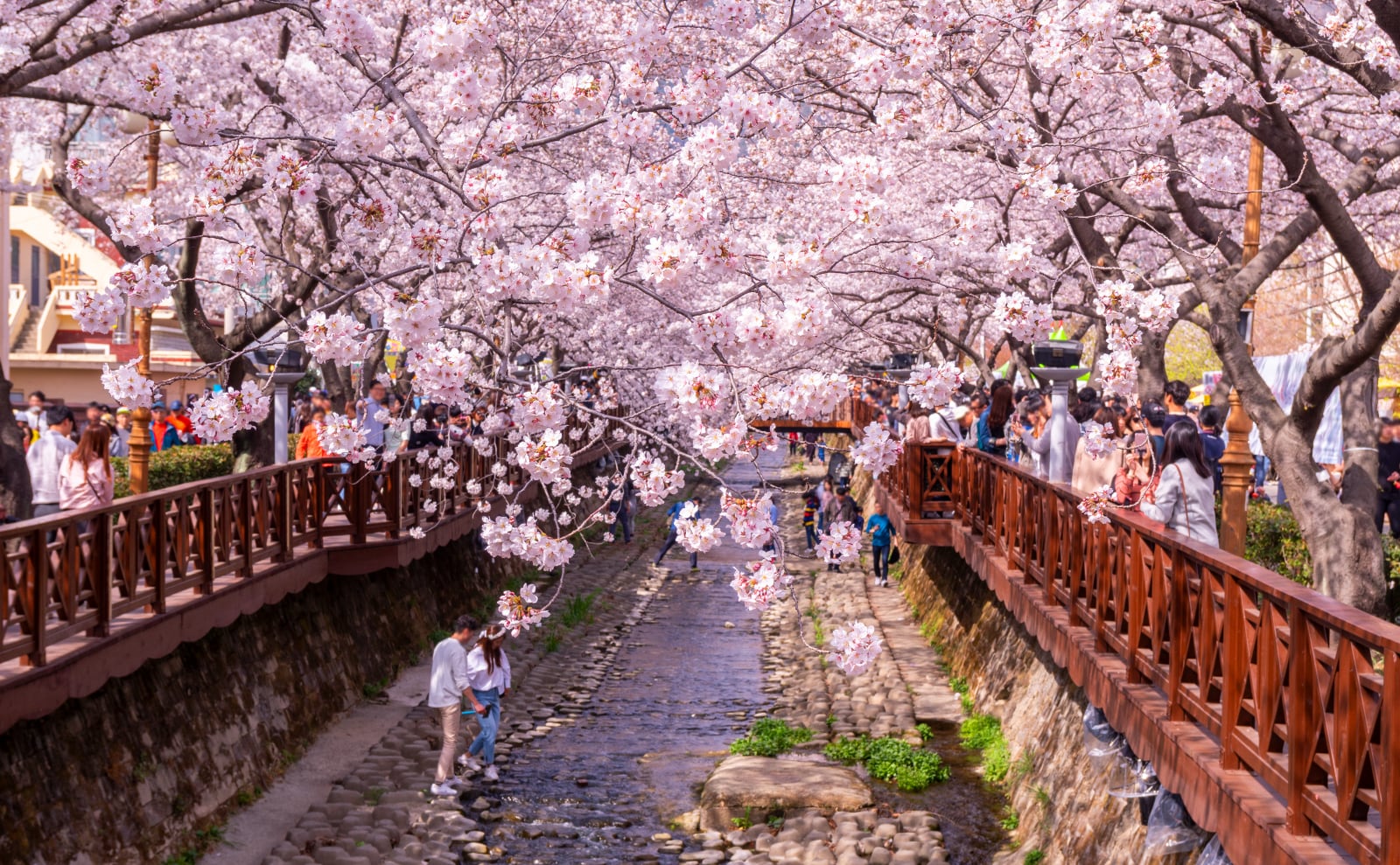
Melissa: The capital of South Korea is Seoul, in the northwestern corner of the country. The city is bisected by the River Han and is surrounded by mountains. The contrast between glittery, modern skyscrapers and the backdrop of cone-shaped mountains — plus colorful buildings with traditional swooping pointed tile roofs. It’s very beautiful! In the spring, the views are framed by pink cherry blossoms, and in the fall, gingko and maple trees turn into flame-colored confetti in gold, red, and orange.
Melissa: South Korea is a predominantly mountainous country, but the mountains are old — worn to soft edges by millions of years of wind and rain. Along the western and southern coasts are the lowlands where farming happens and most major cities are found. And because the peninsula has sea on three sides, there are, of course, plenty of beaches with a vibe to fit every sunbather, swimmer, surfer, and snorkeler.
Melissa: People have been living in the area we know as Korea for at least 10,000 years — but Korean history picks up about 4000 years ago. According to Korean mythology, the first kingdom of Korea was founded by Dangun Wanggeom. His father was a heavenly price who descended to earth to live among the humans and teach them agriculture and civilization. His mother was a bear who wanted to become a human. The prince of heaven challenged the bear to stay in her cave, eating only garlic and sacred mugwort. On the 21st day, the she-bear was transformed into a woman, married the heavenly prince, and gave birth to a son, Dangun, who went on to establish the nation of Korea. He ruled for 1,500 years before he became a mountain god at the age of 1,908. He’s still celebrated with National Founder’s Day on October 3.
Melissa: When Europe was experiencing the Medieval Period and the Renaissance, Korea was in its Dynastic Eras. That’s when the language, culture, and social rules were established that still govern behavior today.
Melissa: The last royal dynasty of Korea was the Joseon Dynasty. I’ll be talking about it more when we get to books. For now, just know the Joseon era lasted for more than five centuries, from 1392 until 1910, when the Japanese showed up. Japan’s rule was brutal: the Korean language was banned and schools were forced to teach Japanese; Koreans were forced to adopt Japanese-style names; land was confiscated; Koreans lost freedom of speech, press, and assembly. Peaceful protests in 1919 were suppressed with violence. Then during WWII, hundreds of thousands of Koreans were forced into even more dire circumstances: the men into hard labor, then women into sexual slavery as comfort women. If you’ve read the novel ‘Pachinko’ by Min Jin Lee, you’re familiar with these terrible details.
Melissa: At the end of World War II, Korean was split by the US and the Soviet Union into two countries. The Soviet Union installed a communist government in the North, and the US supported an anti-communist leader in the South. That was in 1948. Two years later, the North invaded the South. In the north, it’s called the Fatherland Liberation War. In the South, its known as the 6-25 War in recognition of the date it started: June 25, 1950. The US called it the Korean War and sent US troops, along with UN military forces, to the Peninsula to push back on communism. When the fighting got too close to the Chinese border, China got involved. After three years, in 1953, North Korea, China, and the United Nations signed an armistice agreement. That stopped the fighting, maintained the North-South division, and created the Korean Demilitarized Zone - the DMZ. No official peace treaty was ever signed, which means both countries are still technically at war.
Melissa: The official name of South Korea is the Republic of Korea — because the government does not recognize North Korea as a separate country and claims to be in charge of the entire peninsula. As of May 6, 2026, North Korea officially recognized South Korea as a separate state for the first time.
Melissa: Which, I recognize, all sounds contentious and grim. But South Korea is not! Herre’s a short list of the fun things that South Korea has given us: K-Pop music which is pretty much the definition of catchy tunes and flashy choreography. K-Dramas like the Extraordinary Attorney Woo and Squid Game. You know those crispy spiral potato sticks? [DAVE] They were invented in South Korea in the early 2000s — and those little coffee stocks with coffee, creamer, and sugar in one package? They’re also a Korean invention from Dongsuh Foods in 1976.
Melissa: So! Let’s talk about the fun things you might do in Korea.
Melissa: I put together a magical itinerary that completely ignores the real-life limits of space and time. If you want real intel on how to plan a trip to South Korea, I recommend the Lonely Planet guide. It has practical tips on traveling there and itineraries for visiting specific areas of the country with a day-by-day breakdown of what to see, do, and eat.
Melissa: But onto our pretend journey!
Melissa: Since Seoul is the capital, we’ll start there. Our day will begin with Korean street toast. It’s soft milk bread made into a toastie with butter on a griddle. It’s filled with a thin veggie omelet, ham, and American cheese. It’s finished with condiments that sound so weird they can only be delicious: a drizzle of ketchup and mayo, and a light dusting of sugar.
Melissa: With full bellies, we’ll head up the Inwangsan Mountain Trail. It’s a 3-mile (5k) route along old fortress walls that ends, at the top, with panoramic views of the city. Along the way there’s a metallic gold statue of a tiger and, irresistible to me, stone and wooden stairs, along with dirt paths and granite rock faces. The roundtrip takes about two hours.
Melissa: Back in the city, we’re off to Museum Kimchikan, devoted to the 1500-year history of kimchi. It’s sort of like Korean cole slaw if instead of mayo, you used hot sauce. And it punched you in the face. Kimchi is made from fermented cabbage seasoned with garlic, ginger, and Korean chili powder. At the museum, you can sample different varieties of kimchi, visit the lab to see the lactic acide bacteria under a microscope, and take a class to make kimchi yourself.
Melissa: Our next stop is the DMZ. It’s about 2 1/2 miles wide (4k) wide and 155 miles (250km) long, running the whole length of Korea’s northern border. You can only visit the Demilitarized Zone on a half- or full-day group tour. There’s a bridge called The Bridge of Freedom. It’s the spot where prisoners were exchanged after the war. It’s now blocked off and surrounded by a fence is covered in colorful prayer ribbons. You can also go down into a tunnel that was dug under the border by North Korea and discovered in 1978. At the Dora Observatory, you can use binoculars to look across the border into North Korea. And some tours include the Gamaksan Suspension Bridge. It’s the longest suspension bridge without towers in the country, and it looks like you’re just walking on the treetops.
Melissa: The DMZ seems like a weird mix of tourist attraction and memorial — which is kind of the situation with the open-air Berlin Wall museums, too. But there is something optimistic about the DMZ. Because it’s been closed to humans for 70ish years, it accidentally became a wildlife sanctuary. It’s home to almost 6200 wildlife species, including endangered animals like the Siberian musk deer, the Asiatic black bear, the Korean goral — which looks like a wise goat — and a tiny feline. It’s called the leopard cat, and it’s the size of a house cat but has the markings of a leopard. There are also river otters that pay absolutely no attention to political borders.
Melissa: Now we’re heading south to the city of Jeonju to visit a hanok village. The hanok is a traditional Korean house built from organic materials like wood, clay, stone, and mulberry paper. They’re positioned facing south to optimize sunlight and breezes — and the curbed tile roofs are angled to block harsh sun. It’s a real town, not a museum. Some of the homes have been turned into accommodations where you can spend the night. One of the blogs I read said that sleeping in a hanok and its bed — which is a thin sort of futon mat on the floor — is both uncomfortable and a must.
Melissa: In 2012, Jeonju was named a UNESCO City of Gastronomy in large part because it’s where the classic rice dish bibimbap was invented. It’s a bowl of hot rice served with steamed vegetables, thinly sliced, marinated beef, and a fermented red chili paste — and then a perfectly cooked fried egg is perched on top.
Melissa: Next we’re going even further south, to the island of Jeju — known as the ‘island of the gods’ — ancient stories say it was founded by three demi-gods who emerged from holes in the ground. It’s also nicknamed the ‘Hawaii of Korea’ because of its paradise-perfect beaches and rocky volcanoes.
Melissa: If you’ve read the novel ‘The Island of Sea Women’ by Lisa See, then you’re familiar with the haenyeo who lived on Jeju. They’re the legendary female free-divers who collect abalone, conch, octopus, and sea urchins from the sea floor while holding their breath for up to two minutes.
Melissa: We will not be doing that! There are plenty of beautiful beaches for splashing and strolling. But we’re going hiking! On the Jeju Olle Trail. It’s a network of 27 interconnected walking routes that circle the island. They pass by salt flats, beaches, pine forests, and stands of cedar, oak, and cypress tress.
Melissa: For our last stop, we’re heading northeast to Korea’s second city: Busan. My only reference point for Busan prior to this was the zombie movie ‘Train to Busan.’ But what we’re doing is completely different. We’re going to Beomeosa, the Temple of Nirvana Fish. You can visit for a day program or stay overnight, which includes accommodations and communal meals with the monks. The experience includes a temple tour, meditation sessions, a tea ceremony, a mindful walk, and maybe a class to make paper lotus-flower lanterns or a string of prayer beads. Sometimes they assign you chores around the temple! (I’m weirdly into that idea.)
Melissa: I also read that at some temples, a ritual of 108 bows is performed at dawn. Each bow starts by bending at the knees with hands in prayer position, then the knees are lowered onto a meditation cushion, and you bow your head to the floor. Then stand up! That’s one. And that’s repeated 108 times. I’m weirdly into that idea.
Melissa: That’s the South Korea 101.
David: Are you ready for Two Truths and a Lie? I’m going to say three statements; Mel doesn’t know which one is the lie. Statement 1: There’s a Korean app. The name translates to Groom. People use it to find local weddings to crash.
David: Statement 2: In the 70s, a bunch of guys digging a drainage ditch found a royal tomb that had been sealed for 1500 years. And statement 3: The world’s oldest printed book is Korean.
David: Let’s take them one at a time. There’s a Korean app. The name translates to Groom. People use it to find local weddings to crash. You open it up, and it shows you real weddings happening near you, today — venue, time, what you should wear, whether there’s an open seat — so you can just show up.
Melissa: My mom would love that! She loves to crash a wedding. But do other people want to do that?
David: Koreans believe the more guests at a wedding, the luckier the marriage. So crashing one with Groom isn’t rude — you’re doing the happy couple a favor. You get a seat and some cake. They get some luck. Everybody wins. I would like that to be real. A ‘come crash my wedding’ app? Aw. It would be a better world. It’s not. I made it up. I invented ‘Groom’ because South Korea has a real category of apps that I wanted to talk about. They’re called ‘dopamine sites.’
David: The clearest example is an app called FoodNeverComes. It works exactly like a food delivery app — full menus, photos, customer reviews, a shopping cart — and once you ‘place’ an order, you watch a little courier icon crawl across a map toward your address, just like the real thing. Except there’s no charge. And the food, as the name cheerfully promises, never comes.
David: Its developer — who goes by ‘Malhee’ — has said it started as a joke. He had a late-night habit of opening and closing a real delivery app out of boredom, never ordering. They built a version where they could complete that whole ecommerce ritual – without the guilt or the bill at the end. It caught on.
David: This idea did not stop with food. There’s a fake shopping site, called FakeHaul, that gives you the full browsing, add-to-cart, checkout experience for clothes and gadgets you’ll never see. It has periodic sales, so you can price-watch on imaginary objects.
David: And there’s an even stranger cousin of the genre — a site called Damta [Dahm-tah] World. That’s built around a virtual cigarette break: you hit “start,” a cigarette starts burning on screen, and you sit anonymously alongside strangers who are all, apparently, also just sitting there, some of them leaving little messages like “getting through another day” or “just want to go home.”
David: There’s some psychology behind why this works; it’s might not be as silly as it sounds. Dopamine spikes mostly in the anticipation of a reward, not in the moment you receive it. It’s a big part of why gambling and slot machines are so compelling even when you lose more than you win. These sites are harvesting that anticipation and quietly discarding the part where you’d normally spend money or overeat.
David: It’s landed in Western media this year, mostly filed under ‘look at this weird internet trend,’ but the people using these sites, and the young Korean developers building them, put it more simply: rising cost of living, a lot of loneliness, and a very cheap, very safe way to feel, for about thirty seconds, that you’ve done something nice for yourself.
David: Statement 2: In the 70s, a bunch of guys digging a drainage ditch found a royal tomb that had been sealed for 1500 years. This is true!
David: n July of 1971, a work crew in the small South Korean city of Gongju was doing about the least glamorous job imaginable — fixing a drainage ditch — when a shovel hit brick where there shouldn’t have been any.
David: They were working right next to a cluster of ancient burial mounds that everyone in town already knew about. Gongju sits on the site of Ungjin, an old capital of an ancient kingdom, one of the three rival kingdoms that ruled the Korean peninsula fifteen hundred years ago. The surrounding hillside had been a known, mapped, thoroughly excavated archaeological site for decades. Every tomb in that hillside had already given up its treasures, most of them centuries ago. They’d gone to grave robbers, invading armies, and the churn of history. So when the drainage crew broke into a brick chamber that afternoon, nobody was expecting much. Probably just another looted tomb.
David: It wasn’t looted. It hadn’t been touched in fifteen hundred years.
David: Inside, archaeologists found roughly 4,600 objects — a gilded bronze crown, ornate gold hairpins, silver bracelets, shoes so delicate they look more like sculpture than footwear. But the single detail that makes this find historically singular isn’t the gold. It’s two stone tablets sitting near the entrance, inscribed with a formal epitaph. They named the tomb’s occupant: King Muryeong, twenty-fifth ruler of Baekje, who died in the year 523. That doesn’t sound like it should matter that much — but almost no other tomb from this era in Korean history can be attributed to a specific person. Every other royal tomb from this period is an educated guess. This one has a name tag.
David: What happened next makes archaeologists wince, though. Word got out fast, and the pressure to see what was inside was immense — reporters and officials were reportedly already gathering at the site within a day. So instead of the months of careful, layer-by-layer documentation a find like this would get today, the whole excavation happened in a single overnight session. They saved essentially everything. But the context — which object sat where, how the burial was arranged, all the information that tells you not just what was buried but a little more how and why — a lot of that was lost. There wasn’t time to record it properly before things got pulled out and passed along the line.
David: It was a strange kind of good news. Korea got its single most important archaeological find of the twentieth century, an untouched royal tomb, a named king. They built a museum in Gongju to house what they found. And it’s also become the textbook cautionary tale archaeology students still get taught today: what happens when you excavate at the speed of a news cycle.
David: If you want to go see the treasures, it’s an easy day trip from Seoul — the gold crown and the rest of the haul are on display at the Gongju National Museum, and it’s free.
David: Statement 3: The world’s oldest printed book is Korean. If you had asked me last week who invented printing, I would have said Gutenberg. In the mid 1400s. And I would have been wrong, by about 80 years and half the world.
David: In 1377, at a Buddhist temple in the city of Cheongju, monks printed a book called Jikji. That was a collection of Zen Buddhist teachings. They didn’t carve the whole page into a block of wood, the way most printing worked then. They cast individual metal characters, arranged them into pages, printed from that arrangement, then broke it back down and reused the pieces for the next page. That is movable metal type — the same idea Gutenberg would supposedly pioneer in Europe in 1455. Except Korea was doing it over seventy years earlier.
David: Now if you want to see the world’s oldest surviving printed book, you don’t go to Korea. You go to Paris.
David: In the 1890s, Korea was opening itself to the outside world, and a French diplomat named Victor Collin de Plancy picked up a copy of Jikji — really, half a copy, since only the second of its two volumes has ever surfaced. He bought it somewhere in Korea and brought it home. It passed through a private collector’s hands and eventually landed at France’s National Library, where it sat, unknown and misfiled, under the plain catalog name ‘Korean Book 109,’ for over twenty years. Nobody there seems to have known what they had.
David: Then, in the late 60s, a Korean librarian named Park Byeong-seon — twenty years into living in Paris by then — landed a research post at the National Library. In my imagination, someone hands her a pile of Korean-language material and says, ‘Would you mind sorting through this? Nobody here can make heads or tails of it.’ And somewhere in that pile, she recognizes what she’s holding.
David: I want this to be an Indiana Jones moment. Golden light, triumphant music, the whole bit. I’m not sure it was at all. It took her the next three years to confirm that this unassuming little book, misfiled among the stacks, was the oldest surviving printed book on Earth.
David: Park spent the rest of her career pushing France to acknowledge and return Korean cultural property — first with Jikji, then a set of ancient royal court protocols called the Oegyujanggak. French troops had looted those from Korea’s royal library in the 1800s. She said that her advocacy made her unwelcome in both places. ‘In France, I’m considered an enemy and hated. In Korea, I’m considered a nuisance.’ By her own account, she never once regretted any of it. She said it was a calling.
David: She lived to see one major accomplishment. In 2011, France agreed to return 297 volumes of the Oegyujanggak to Korea. They remain there on a renewable five-year lease rather than a permanent handover. Park died later that same year, in a Paris hospital, in her early 80s. She’s now buried at the National Cemetery in Seoul.
David: UNESCO made Jikji’s status official in 2001: it is the oldest known book printed with movable metal type anywhere in the world. And it is, to this day, still in Paris. Korea has asked for it back, on and off, for decades. France has, so far, said no.
David: But at least we know where it is. All of this started because one tenacious librarian, sorting through a pile of Korean volumes nobody else wanted to touch, suspected what she was holding — and spent the next three years proving she was right.
Melissa: My first recommendation is ‘Winter in Sokcho’ by Elisa Shua Dusapin, translated from French by Aneesa Abbas Higgins. This is a quiet novella that punches well above its weight.
Melissa: Sokcho, the city in the title, is a popular beach town on the northeast coast of South Korea, very close to the North Korean border. The terrain is pretty magical. You can stand on the sandy beach with water lapping at your ankles and gaze at mountains in the distance. Just a short walk from the water is a grove of pines where the scents of salt water and pine needles blend together. There’s a Ferris wheel and paddleboarding. And in the summer, you can eat seafood just pulled from the water at pop-up stalls, balancing a paper plate on your lap as you look out over the East Sea.
Melissa: The setup of this book is very simple. Our narrator is a young woman — she’s in her early 20s — who works as a receptionist at a down-at-its-heels guesthouse. It’s the off-season in Sokcho. It’s cold, gray, and uninviting. The whole town feels like all it wants to do is sleep. Our narrator’s life is uneventful, but not soothing. That routine existence is interrupted by the arrival of a surprise hotel guest: a French cartoonist seeking inspiration for his new book.
Melissa: Our unnamed narrator has a truly terrible boyfriend and steadfastly resists the judgments and expectations set by her Korean mother. Her father, a Frenchman, is not in the picture — but our narrator has learned to speak French from books.
Melissa: Taken together, that all means she’s primed to be painfully curious about Yan, the cartoonist from Normandy. She secretly watches him draw. She cooks Korean food for him, which he does not eat. But! He does ask her to show him Sokcho through her eyes.
Melissa: What follows is a few weeks of not much and also everything as the two of them spend time together and slowly reveal small glimpses of themselves. They visit the snowy countryside, the chilly beaches, and the fish market where her mother works. They explore a Buddhist temple and the demilitarized zone. Their relationship is a little opaque: their feelings are complex and ambiguous.. The author does a brilliant job encapsulating the unsettled feeling of being not being bold enough to ask for what you want. Or maybe not even being able to identify what you want. So events just… happen to you.
Melissa: I listened to the author talk about her book on a podcast after I finished it, and it added another layer to the reading experience.
Melissa: The author — Elisa Shua Dusapin — is herself French-Korean. She didn’t visit Korea until she was 14, and she learned to speak the language only through literature and study. She said that her heritage has always made her feel out of place, but also in two places at once. When she started writing, she wanted to make a character that’s a mirror of herself. So she created a girl in Korea who speaks only book-French.
Melissa: Something else I enjoyed is the significant role that language plays in the book. The author wrote the story in French. The narrator speaks Korean most of the time. But when the narrator and the cartoonist talk to each other, it’s in English. So the author had to capture the idioms and rhythem of each language to make the characters feel right. And the translator Aneesa Abbas Higgins had to take all of THAT and put it into English in a way that preserved the essence of the original. What kind of hoodoo voodoo is that?
Melissa: The book won a bunch of French literary awards and the 2021 National Book Award for Translated Literature; it’s subsequently been translated into six languages.
Melissa: And now that I’ve spent all that time talking about the language: Even though it’s beautifully written — and it is, it’s just lovely — I could also see this book working as one of those graphic novels without words. The characters rarely say explicitly what they mean, and it’s left to us to interpret the meaning in their words in the same way we need to bring meaning to the images in a word-less comic.
Melissa: It’s a powerful little book that tenderly addresses themes of identity, loyalty, and vulnerability. All of it happens in just 160 pages. It would be a lovely book to revisit every winter — in that January-February timeframe that sorta feels like hibernation. I wasn’t ever sure where the story was going, and I loved that the author didn’t do anything predictable.
Melissa: It’s ‘Winter in Sokcho’ by Elisa Shua Dusapin, translated from French by Aneesa Abbas Higgins.
Melissa: I should also mention that she has another novella that came out at the beginning of this year, also translated by Aneesa Abbas Higgins. The book is called ‘The Old Fire,’ and it follows two estranged sisters as they clear out the old family estate in France after their father’s death.’ I will be reading that immediately, obviously.
David:
Melissa: My second recommendation is ‘If I Had Your Face’ by Frances Cha. This is the story of four young women, friends, who all live in the same apartment building in the Gangnam district of Seoul. It’s a slice of life novel, and for the sixish hours it took to read it, I felt like I was part of their little found family.
Melissa: I usually try to avoid dropping too many character names in my book recommendations, but these women felt so real to me, I don’t want to reduce them to generic descriptors. So I’m going to introduce you like they’re real people.
Melissa: The most beautiful and most troubled is Kyuri [gyoo-ree]. She’s had multiple rounds of cosmetic surgery so she is PERFECT. She’s a hostess at a ‘room salon.’ That’s a very exclusive, private bar where rich men pay for lots of alcohol and the company of gorgeous women. Kyuri works in the ‘10 percent’ room — which, as she explains, is ‘a salon that supposedly employs the prettiest 10 percent of girls in the industry — where the madam isn’t blatantly pushing us to have sex with clients.’
Melissa: Her roommate is Miho, a gifted artist who grew up in an orphanage, then won a scholarship to study in New York. She’s now engaged to the scion of an ultra-rich Korean family known as a chaebol [CHAY-bowl]. That’s the Korean word for a family-owned industrial conglomerate.
Melissa: Down the hall is Ara who lost her ability to speak in the aftermath of a traumatic event. She works as a hairstylist, but what she cares about most is the lead singer of a famous K-pop band. Each night, she calls into a number to hear a recorded message from him.
Melissa: And finally, there’s Ara’s best friend Sujin [soo-jeen]. Her life’s dream is have enough plastic surgery that she will be glamorous enough to work in a 10-percent salon room. When she does finally go under the knife, the results are not what she hoped they’d be.
Melissa: The girls live in an office-tel — a portmanteau of office and hotel. They’re high-rise apartments that legally allow both residential living and small-businesses in the building. The one they live in is called ‘Color House’ even though, the building is gray. Miho, the artist, says: ‘There isn’t a speck of color anywhere across the entire four stories and the rent is dirt cheap, but only on our floor.’
Melissa: It’s cheap because they live on the fourth floor. The Korean words for four and death sound the same, so there’s a belief that the fourth floor is dangerous. Many hospitals, commercial buildings, and elevators in Korea skip the 4th floor entirely.
Melissa: Even though the girls live in Gangnam, their corner of the stylish neighborhood is a little run-down. One of the characters says, ‘During the day ours is an ugly street, washed out and dusty with trash piled up and cars honking and trying to park in odd corners, but at night, the bars light up brilliantly with neon signs and flashing televisions.’
Melissa: That’s a perfect example of the vibe of this book — that peek inside everyday life in Seoul. It’s the opposite of the show ‘Sex and the City’ with its glossy bars and restaurants. These girls lounge around their apartments, eating ramen in front of the TV or nursing their morning-after headache with hangover stew. [DAVE - bone broth with soybean paste, bean sprouts, cabbage, and sometimes congealed ox blood]
Melissa: The author Frances Cha comes from a journalism background — she was a travel and culture reporter for CNN in Seoul — and she does not candy-coat our characters’ situation. They live in an extremely capitalist, consumerist, patriarchal society in which physical beauty is prioritized over almost everything else.
Melissa: In real life, South Korea ranks first in the world for cosmetic procedures per capita. Somewhere between 33 and 50% of women aged 19 to 29 have had at least one surgery.
Melissa: In the world of this book, plastic surgery isn’t only for the vain; it’s practically a requirement for social acceptance. Ara, the hairstylist who doesn’t speak, says wryly that half of the girls at her school got their eyes done at the same time because the surgeon was a teacher’s husband — and offered 50% off.
Melissa: Each chapter is narrated by a different woman, and we follow the small adventures and heartbreaks of their days. About halfway through I wasn’t sure I wanted to keep going. The grind of small and large humiliations these women put up with never stops.
Melissa: But — the writing is excellent. I feel like I’ve been to their gray building in Gangnam, and the dialogue is very lived-in. The story is not completely without hope. As the narrative moves along, the four women deepen their bonds with each other and their commitments to themselves. They changes are incremental, to be sure, but when the book ends, we know it’s not the end of their story. And there’s a shimmer of hope. That’s ‘If I Had Your Face’ by Frances Cha.
David: First, a quick word about a genre I really enjoy: the graphic cookbook. This is a cookbook drawn like a comic instead of shot in photos. Done right, it steals the best trick from a cooking video — you watch the hands actually do it, garlic getting crushed, dumplings getting folded — without losing the best trick of a book: it holds still. You can see the whole recipe at once, or flip back three panels instead of scrubbing a video bar. A good cartoonist can simplify and focus in a way that’s hard to do in photography. And using that superpower to teach cooking is just — pun intended — chef’s kiss.
David: Graphic cookbooks are a small genre — maybe fifteen years old in its modern form. At least in the US. The first one I remember was ‘Dirt Candy,’ by Amanda Cohen, Ryan Dunlavey, and Grady Hendrix. That’s the story of a scrappy, all-vegetable start-up restaurant in Manhattan. It reads more like an entertaining calling card for the restaurant than something you’d cook from on a Tuesday. But it does have some fantastic project recipes. There’s a dessert called Red Pepper Velvet Cake, which is served with a chunk of peanut brittle and a scoop of peanut ice cream. I’ve been curious about that for fifteen years.
David: Another graphic cookbook is Lucy Knisley’s ‘Relish.’ That kind of goes the other way — quieter, more of a memoir that happens to feed you than a cookbook that happens to tell a story.
David: My first book sits in a third spot between those two. It’s ‘Cook Korean!’ by Robin Ha.
David: he cover is a shout. A comic-style speech bubble on the title page just says ‘Cook Korean!’ over a yellow field — like the book is a friend grabbing you by both shoulders. Inside, it delivers sixty-some recipes over ten chapters. It’s got everything from kimchi and pickles to soups and stews to street food. There’s a whole chapter of drinking snacks — anju — and a Korean Fusion chapter at the back for things like kimchi-galbi burgers. The closest English translation for ‘kimchi-galbi’ might be ‘short ribs and pickles,’ but it’s got some umami thrown in there.
David: There’s more going on here than recipes, and it starts on page one — Ha admitting she grew up with zero interest in cooking at all.
David: Her mother did everything — fast and wordlessly. Ha figured cooking was something she’d never be able to do. She lived on instant ramen through college. Then on a homestay in Italy, a host mother taught her pasta and grilling. When she got back home, cooking became her decompression from work. Friends kept asking how she made her food, and she couldn’t explain it — “Most Koreans don’t measure anything while cooking. Besides, I am a cartoonist, not a chef.” So she started a Tumblr called ‘Banchan in Two Pages’ — bahn-chahn, are the small side dishes served with a Korean meal. She’d draw her recipes out panel by panel. This whole book grew out of that.
David: Along the way, Ha drops off useful bits of culture. She introduces what’s in the Korean refrigerator, ingredient by ingredient – and what’s in the pantry, what the shape of a traditional meal is like. She gets into Korean drinking culture, and what the rituals are there. So she writes, “Never refuse a drink from your elders. Receive your drink with both hands. Drink it facing away from your elder.” There’s even a 1-page folk story in here, about how a dish might have gotten its name.
David: It’s the acknowledgments page though that really adds some emotional oomph to this work. In the last page of the book, Ha writes that she’d barely cooked with her mother — despite growing up eating her mother’s food — until she started this project. The eight months of recipe-testing together became “an emotional roller coaster.” She closes with a lines: We find it so difficult to say ‘I love you’ out loud to each other. Maybe we are too tough, shy, or stubborn. Or maybe those words just can’t contain all of our feelings.
David: That line lands even harder once you know the rest of Ha’s work. Her 2020 memoir, ‘Almost American Girl,’ tells her story. She grew up in Seoul, raised by her mother alone, and at fourteen she’s told they’re going on vacation to America — nothing more than that. They land in Huntsville, Alabama, and stay with a Korean family there. About a week later, her mother drops the real news: they’re not going back. Ever. Mom is going to marry the nice man who picked them up at the airport.
David: You know. Not a parenting expert. But ‘surprise, new dad, no more Korea’ is not what I’d call top quality childcare.
David: And her most recent book, ‘The Fox Maidens,’ from 2024, takes the same material — an unspoken, inherited maternal burden — and marries it to Korean folklore. It follows a girl who may be the granddaughter of a nine-tailed fox demon. Ha’s author’s note invokes the Korean word han — which is ‘the unsatiated longing for a life fully lived and the need to correct the wrongs done in the past.’ She dedicates the book ‘for those who carry han in their hearts.’ So, three books, one relationship, looked at from three different distances: memoir, myth, and a cookbook.
David: You don’t need any of that to enjoy ‘Cook Korean!’ The recipes work on their own, the kimchi instructions are worth the cover price. The immersion into the culture and its food is deep and satisfying and well done. Somewhere between the ingredients list and the acknowledgments page, this stops being a cookbook and starts being a love letter to a difficult relationship. That’s ‘Cook Korean!’ by Robin Ha.
Melissa: My final recommendation is ‘Behind Five Willows’ by June Hur. This is a retelling of Jane Austen’s Pride and Prejudice set in 18th-century Korea, during the Joseon Dynasty.
Melissa: As I said in the 101, the Joseon dynasty ruled for more than 500 years. During the early centuries, it was a cultural and scientific golden age — with the creation of the phonetic alphabet, movable type, hanok homes with their smart design, sundials, and celestial globes. So much progress!
Melissa: But in 1875, the King banned the writing and reading of fiction. He straight-up didn’t like novels — and he was concerned about the influence of Western knowledge and Catholicism. There was a fear that a novel might be hiding dangerous ideas against Confucianism or the State within their words.
Melissa: Buddhism had been practiced in Korean since the 4th century. But in the late 1300s, scholars viewed Buddhism as disruptive and leaned into the rules and etiquette of Confucianism — which meant an emphasis on respect for the State and a shift toward rigid patriarchy.
Melissa: The marriage practices of the time will also raise some eyebrows now. When a king or crown prince was on the hunt for a new wife, the state issued a temporary ban that prevented single women — aged 15 to 25 — from marrying anyone until the royal gentleman had selected his new mate. And, not unlike the British Regency era, there was a stigma attached to being an unmarried woman. In the neo-Confucian society, a single girl past her early twenties was a problem to be solved. Worried parents would quickly marry their daughters off to make them seem more respectable — or to avoid them being chosen by the king.
Melissa: The author June Hur uses both of these historical bits — the book edicts, the marriage laws, Confucianism — to put a fresh, Eastern spin on the marriage plot of Jane Austen’s original.
Melissa: The story is set in 1792, in Gyonam Village, just outside one of the historic gates in the fortification wall around the old capital. Six of those gates are still standing in Seoul today.
Melissa: Our heroine is Haewon. She’s a second daughter — well mannered, but inquisitive. Kind-hearted, but no pushover. She loves to read novels, and she has a secret identity. Working under the name Magpie, she earns a little extra money by copying books for an underground lending library.
Melissa: Her favorite books to read and transcribe are by Black Lotus, a mysterious author who writes exciting adventure novels. Unbeknownst to Magpie, Black Lotus is really Seojun, also known as Lord Yu, the only son of a nobleman. He’s the city’s most eligible bachelor and lives in a manor house with 99 rooms.
Melissa: Haewon’s older sister must get married. A new decree requires that all unmarried women aged 24 were required to wed — or have their spouse chosen by the state. The very beautiful Jade had been named of the 281 spinsters in the capital. Happily, she is soon smitten with a very nice young man — who just happens to be best friends with Black Lotus, the noble, arrogant, condescending, and very handsome writer.
Melissa: Thanks to chaperoning requirements, the four young people are thrown together. And for a while, we know the true identities of Magpie and Black Lotus, but they do not. Which makes for some very amusing scenes. When they do discover their shared passion for the written word, serious hijinks ensue.
Melissa: The plot of this book cleverly follows the narrative beats of Pride and Prejudice. There is a lot of writing Very Important Letters — and the text is sprinkled with Victorian lit Easter eggs. There’s a scene that’s lifted straight out of Jane Eyre. Very delightful. But the author does a really nice job of making the particulars of HER story grow out Korean history and social mores.
Melissa: Reading and writing are significant to the characters and to the story. The verbal sparring between our hero and heroine is delightful, especially when they argue about the aim of the written word. Is it meant to dictate morality — or is it an expression of emotion and the self?
Melissa: One of the funniest — and to me, best — complaints about Jane Austen’s books is that it’s just a bunch of people going to each other’s houses and talking. This book has some of that, but it also has a surprising number of action scenes: there’s a raid a the bookstore, a house of ill repute, a massive storm, frantic horseback rides, and the dramatic revelation of secrets.
Melissa: Although this is a retelling of a classic, it stands on its own as historical fiction. It’s a painless, charming way to learn about Koreana history — and, not for nothing, there’s kissing.
Melissa: The author June Hur has built an award-winning career on what she calls love letters to her Korean heritage. She won the Edgar Allan Poe Award for Best Young Adult Novel in 2023 for her historical mystery The Red Palace. It’s also set during the Joseon period and follows a palace nurse caught up in a murder mystery. This one just came out in May. It’s ‘Behind the Five Willows’ by June Hur.
David:
Melissa: A quick heads up for anyone who might be in London between now and the end of January 2027. The British Museum is putting on a big exhibition devoted to Korean art from 300 BCE to the present. Almost all of the pieces are from a single source: the collection of Lee Kun-Hee who was the former Chairman of Samsung. The show will feature Bronze Age body ornaments made of gold, a folding screen from the Joseon dynasty, pottery, ink paintings, sketches inscribed on cigarette foil, and a very beautiful 20th century portrait of a woman in a red dress. I’ll put relevant links in the show notes.
David: Those are five books we love, set in South Korea. Drop by our show notes at strongsenseofplace.com for links and details. We’ll point you to FoodNeverComes. So you, too, can order a meal that will never appear. It is weirdly fun. We’ll hit you with some K-pop. I can’t dance to it, and I don’t know what a comeback is, but I love it anyway. Grooves will be had.
David: Mel, where are we going for our next episode?
Melissa: We’re breaking our format entirely and devoting an episode to shenaniganery.
David: Thanks for listening, and we’ll talk to you soon.
[cheerful music]
Top image courtesy of CJ Nattanai/Shutterstock.