This is a transcription of Boarding School: Crushes, Cliques, and Curfews
David: Hello. Welcome to Strong Sense of Place.
Melissa: In each episode, we focus on one destination and discuss what makes it different than any other place on Earth.
David: Then we recommend five books we love that took us there on the page.
Melissa: I’m Melissa Joulwan.
David: I’m David Humphreys.
David: We’re going around the world one great read at a time. Thanks for joining us.
[cheerful music]
David: Welcome to Strong Sense of Place. Today we get curious about boarding schools.
David: Today on Two Truths and a Lie: a boy who bicycled sixty miles alone because he refused to be late, a school that packs up and moves every winter, and a famous children’s fantasy that turns out to be a bit of a memoir. Then we’ll talk about five books we love.
Melissa: I’m recommending a weird and wonderful book by Charlotte Brontë set at a boarding school in a fictional version of Brussells, Belgium.
David: I’ve got a book that took one look at every magical boarding school novel ever and said, ‘yeah, but what about the paperwork?’ But first, Mel’s going to bring us up to speed with the Boarding School 101.
Melissa: For today’s 101, I’m going to talk a little bit about the history of boarding schools in real life, why they’re such a rich setting for storytelling, and the various boarding school sub-genres. We’re going to talk about a LOT of books.
Melissa: When I started poking around to find the oldest boarding school, I appropriately, came upon a rivalry. Two institutions claim to be the longest continuously operating boarding school. I’ll tell about both to save their tender feelings.
Melissa: First up: The King’s School in Canterbury, England. There is no argument that is is the first, which makes it the oldest boarding school in the world. Since 597, students have been hauling their books among its green lawns and Gothic stone buildings. It was founded by St. Augustine — patron saint of theologians, printers, and brewers — along with Canterbury Cathedral — which later, of course, was the destination for the pilgrims in Chaucer’s Canterbury Tales.
Melissa: For nearly 1400 years, The King’s School has educated hundreds of thousands of boys — including princes, politicians, scientists, and some names you might recognize:
- Shakespeare’s theatrical rival Christopher Marlowe
- Somerset Maugham, who wrote Of Human Bondage
- William Harvey, the Renaissance physician who discovered blood circulation
- and — surprise! — the actor Orlando Bloom
Melissa: In the early 1970s, the school began admitting girls for sixth form — that’s like 11th and 12th grade in the US. The King’s School became fully co-ed in 1990.
Melissa: Our other contender for longest continuously operating boarding school is Winchester College in Hampshire, England. That old pile of was founded in 1382 as a feeder school for New College, Oxford. Side note: New College was called New College to differentiate it from Oriel College which was the quote-old college - founded 60 years earlier.
Melissa: Back to Winchester! Boys ages 13 to 18 studied the classics and lived by the motto ‘Manner Makyth Man.’ Until the pesky girls showed up in 2022. Relevant to our travel and bookish insterests, the school offers guided tours of its medieval hall, cloisters, art collection, lovely garden, and its Gothic library. The Fellows’ Library and archive collection includes medieval manuscripts, early printed books, maps, and more — all housed in dark wood bookshelves, stone vaulted ceilings, and leaded glass windows. There’s a really nice video of highlights from the archive that I’ll put in show notes.
Melissa: These two early schools shaped the idea of how boarding schools should work, and this British model spread to other parts of the world — especially in British colonies like India, Canada, and parts of Africa, but also Switzerland, Russia, China, and a few in the United States.
Melissa: Would it surprise you to know that American boarding schools also go toe-to-toe about which is oldest?
Melissa: West Nottingham Academy in Maryland was founded in 1744, when America was still just thirteen colonies. It claims to be the oldest boarding and day school on American soil. Not to be confused with The Governor’s Academy, established in Massachusetts about two decades later, which makes it the oldest boarding school in New England. But then Phillips Academy enters the octagon. It’s more vague about an actual date, claiming instead, ‘We are, in fact, the oldest incorporated boarding school in the country. Let that sink in. It’s pretty cool.’ To tip the scales in its favor, President George Washington visited Phillips Academy and spoke there in 1789 as part of his tour of New England.
Melissa: Boarding schools are practically designed for drama — in real life and on the page. They’re populated by kids of all ages, and the closed environment is ripe for cliques, bullying, and friendships tighter than family. Living away from home can mean homesickness and loneliness — or inspire rebellion, extreme independence, and mischief. There are built-in power dynamics: students vs teachers, day schoolers vs boarders, scholarship kids vs legacies. The environment is designed to create a lifelong community under good circumstances and long-term conflict under bad. Each school has its own code of conduct, hierarchies, and mythologies that set it apart from the rest of the world.
Melissa: School stories have been popular for centuries.
Melissa: The earliest is Sarah Fielding’s ‘The Governess, or the Little Female Academy,’ published in 1749. It’s the first novel written specifically for children. It tells the story of nine boarding school girls, aged 11 to 14, and their headmistress Mrs. Teachum — very Dickensian name, there. It’s a morality tale: A gift of apples unleashes the dangers of pride and envy among the girls, until the eldest and wisest student Miss Jenny Peace leads the girls to repent their selfishness. It’s available on Gutenberg. The first three paragraphs set my teeth on edge. A snippet for you: ‘This gentlewoman, whose name was Teachum, was the widow of a clergyman, with whom she had lived nine years in all the harmony and concord which forms the only satisfactory happiness in the married state… Mr. Teachum was a very sensible man, and took great delight in improving his wife… she also placed her chief pleasure in receiving his instructions.’
Melissa: In the Victorian era, boarding school stories got much better — but the fictional students’ experiences were markedly worse. In Dickens’ ‘Nicholas Nickleby’ and Charlotte Brontë’s ‘Jane Eyre,’ both of the title characters are forced to attend miserable schools where they’re constantly cold, often beaten, and ceaselessly hungry. Those conditions and the tyrannical headmasters — Wackford Squeers of Dotheboys Hall in Nicholas Nickleby and Mr. Brocklehurst of Lowood School in Jane Eyre — were based on real schools and actual awful people.
Melissa: The American version of a 19th-century boarding school was much kinder. The author Sarah Chauncey Woolsey, using the pen-name Susan Coolidge, wrote a series of books about Katy Carr, a 12-year-old girl who lived in a fictional lakeside town in Ohio in the 1860s. In the first book, Katy is a tomboy, tall and untidy, and always getting into scrapes. In the second book ‘What Katy Did at School,’ she and her sister are sent to boarding school where Katy befriends a prankster named Rose Red, sets up a secret society, and is wrongly accused of sending a note to a townie college boy. Goodreads reviewers are split between finding the books charming and sanctimonious.
Melissa: A bunch of school novels are coming-of-age stories or bildungsroman]. Those two terms are similar but have significant differences. So let’s get nerdy for a minute. Every bildungsroman is a coming-of-age story, but the reverse isn’t true. A coming-of-age story marks the transition from child to adult, usually focused on teenagers during a short timeframe, like a school year or a summer. A bildungsroman dives into the moral and psychological growth of a character over a longer period of time. So something like ‘Looking for Alaska by John Green — which spans exactly 272 days at a boarding school, half before and half after a tragedy is a coming-of-age novel. Versus ‘Jane Eyre’ which sees Jane mature from childhood to motherhood over 20 years.
Melissa: The boarding school setting is ripe for mashups with just about every genre. I’m about to start name-dropping a bunch of great boarding school books. They will all be in the show notes in case you want to explode your TBR. Here we go…
Melissa: Murder mysteries and crime! A crime at a boarding school — disappearance, theft, murder — comes with a built-in closed circle of suspects. Like Maureen Johnson’s super-fun YA series Truly Devious. The teenage girl at the heart of the series is a student at a boarding school in Vermont, and a true-crime fan who solves cold cases on the side. For an adult take, try ‘The Stranger Diaries’ by Elly Griffiths. It’s a murder mystery — set during Halloween season — that mashes together supernatural elements and police procedural at a boarding school that was the former home of a Victorian Gothic author.
Melissa: Thanks to Harry Potter, there’s been an explosion of YA school stories filled with fantasy and magic. But there is a series written for adults with similar themes. It’s the Scholomance Trilogy by Naomi Novik. It’s a dark fantasy series, with a slow-burn romance, set at a boarding school for wizards where the school is sentient and infested with monsters.
Melissa: Related: Boarding schools are a fantastic setting for horror stories. I’m going to be talking about two very fun YA horror novels later, but my number one pick is ‘Plain Bad Heroines’ by Emily M Danforth. It combines historical fiction, Gothic tropes, and a slew of complex female characters across two timelines that intersect at the sinister Brookhants School for Girls on a seaside cliff in Rhode Island.
Melissa: In literary fiction, you’re more likely to have an adult narrator or protagonist looking back on their experiences with the greater understanding — or trauma - or adulthood. The classic is Never Let Me Go’ by Kazuo Ishiguro about a mysterious boarding school in England. Pretty much everyone says to avoid reading too much about the plot and just go in knowing a) boarding school; b) Ishiguro. Two more recent titles are ‘I Have Some Questions For You’ by Rebecca Makkai. It’s about a true-crime podcaster who returns to her former boarding school to teach and gets caught up in an old murder case. And ‘My Dark Vanessa’ by Kate Elizabeth Russell which explores the fallout from a 15-year-old girl’s relationship with a teacher. When it came out in 2020, The Guardian wrote an article titled, ‘Is My Dark Vanessa the most controversial novel of the year?’
Melissa: And finally, the internet’s favorite aesthetic and genre: Dark Academia — which takes the school setting and amplifies it with Gothic architecture, educational elitism, a candlelit aesthetic, and some kind of mystery… maybe even muuuuurder. It started with Donna Tartt’s ‘The Secret History.’ It’s a classic but doesn’t work for this episode because it’s set at a college. However, there are two dark academia books I love set in boarding schools: ‘Special Topics in Calamity Physics’ by Marisha Pessl and ‘If We Were Villains’ by M.L. Rio — both are twisty coming-of-age stories woven into a murder mystery. They’re smart, populated with complex characters and slippery narrators, and get a little tricksy. ‘Special Topics’ has lots of footnotes that reference real and fictional literary works — and ‘If We Were Villains’ is infused with Shakespeare quotes and plot that mirrors the bard’s dramas. That’s the Boarding School 101.
David: Are you ready for Two Truths and a Lie? I’m going to say three statements, Mel doesn’t know which one is the lie. Statement 1: There is a boarding school that changes its location with the seasons.
David: Statement 2: There’s a boarding school in England that still tells the story of a thirteen-year-old boy who, in 1926, biked sixty miles alone on a single-speed to make it to the first day of term.
David: Statement 3: In the 1920s, a British boarding school made a deal with a Scottish whisky distiller: a case of scotch to the headmaster every Christmas, in exchange for permission to test experimental medicinal tonics on the boys during the winter term. The tonics were mostly whisky.
David: Let’s take them one at a time. There is a boarding school that changes its location with the seasons. Oh, how I wish we were talking about some magical druidic boarding school where the students migrate to view the changing seasons. This is not that.
David: We’re talking about Le Rosey, a school in Switzerland. Twice a year, the entire student body of Le Rosey — about four hundred students, plus teachers, plus household staff, plus books and belongings — physically relocates from one school to another, a hundred and fifty kilometres away. Or about 90 miles. They move to ski.
David: Le Rosey was founded in 1880 in the village of Rolle, on the north shore of Lake Geneva. The main campus is a château with sweeping grounds and a sailing centre on a hundred metres of lake shoreline. Students study there from September to Christmas, and again from Easter to summer. In between — for the winter term, roughly January through March — the school migrates northeast, into the Bernese Alps, to a group of chalets in the ski resort of Gstaad.
David: In Gstaad, mornings are lessons; afternoons are skiing. On the mountain, with instructors, in the same ski town where the international jet set books its own winter holidays. The theory is that this teaches character, resilience, teamwork, and the ability to handle a black run. In practice, it means that the students — the school calls them Roséens — get about three months of afternoon skiing every winter, from age eight to age eighteen. You will have gathered that this is a specific kind of school.
David: Le Rosey has held the ‘Guinness World Records’ title of most expensive school in the world since Guinness records started being published, in 1955. The current tuition is about US$180,000. For that, you get: the château in Rolle, the chalets in Gstaad, the sailing centre, the professional-grade skiing programme, tuition and boarding in both French and English, an International Baccalaureate or French Baccalaureate diploma, and a spot in what may be the single most exclusive alumni network in the world.
David: Le Rosey is known as ‘the school of kings.’ Alumni include King Juan Carlos I of Spain; King Albert II of Belgium; royalty from Monaco, Egypt, Iran, Yugoslavia, Britain, as well as a bunch of Rothschilds, Rockefellers, Gettys, and du Ponts.
David: The alumni are called Anciens Roséens. There are about three thousand of them living. Post-graduation, they get access to a private online directory listing the contact details of nearly every other one. That, as much as anything, is what parents are paying for.
David: In more recent years, the graduates have gotten more famous and less royal. Julian Casablancas of the Strokes. Sean Lennon, John and Yoko’s son. Tracee Ellis Ross, Diana Ross’s daughter. Dodi Fayed, whose father owned Harrods and who died in the car crash with Diana. Every generation of children of Roger Moore, Elizabeth Taylor, and David Niven.
David: Just for a second, imagine being a housemaster at Le Rosey. Your job is to keep four hundred teenagers from the world’s most powerful families alive, on time, and — critically — off the international news. I can’t imagine the drama.
David: At any given moment, in the Bernese Alps in January, several of the world’s most powerful families are watching their eleven-year-olds ski. Le Rosey has been running this specific arrangement for a hundred and forty years.
David: OK! Statement 2, about the 60-mile bike ride. On the morning of Monday, May 3rd, 1926, a thirteen-year-old boy got off the ferry at Southampton and discovered that every train in England had stopped. His name was Alan Turing. In a few years, he will go on to help invent the modern computer and break the Nazi Enigma code — arguably shortening the Second World War by two years. But in 1926, he’s a kid who’s late for school.
David: He was due at Sherborne in Dorset that day. Sherborne is about sixty miles from Southampton, and — like most English boarding schools — it took a fairly dim view of pupils who didn’t turn up on the first day of term. Turing’s mother had put him on the boat from Saint-Malo the day before. She was still in France, his father was in India, and he had, in the language of the era, his own arrangements to make.
David: At midnight, a strike had been called. There were no trains, no buses, no reliable postal service. The country had, more or less, gone offline. Turing — 13 at the time — took a look at the station, thought about it a bit – and bought an apple. And a map. Then he cabled his housemaster to say he’d be late. He had a bicycle with him — probably because his mother had built it into her contingency plan. He stashed his school trunk at Southampton station, got on his bike, and set off.
David: Sherborne is sixty miles from Southampton by road. By bicycle, in 1926, on English country roads, in May, according to his housemaster, it was closer to sixty-three. Turing rode from Southampton to Blandford Forum on the first day. He booked himself into the Crown Hotel – which, apparently, was the best lodgings in town at the time. The hotel staff, apparently charmed, charged him a nominal amount and turned out the next morning to see him off. He got back on the bike and finished the trip. He arrived at Sherborne the following day.
David: His biographer Andrew Hodges landed this story with this sentence: ‘For a boy of his class to improvise a solution without a fuss was not at all the expected thing.’ In 1926, an upper-middle-class English thirteen-year-old was supposed to be helpless without adult supervision. Turing was not.
David: He spent five years at Sherborne. He was, by most accounts, unhappy there — as many gifted, awkward boys are at boarding school. Thirteen years after the bike ride, he was at Bletchley Park, cracking the German Enigma cipher.
David: He was, incidentally, still cycling. During the war, he rode to Bletchley Park wearing a gas mask to manage his hay fever. He was also an almost-Olympic-level marathon runner. His marathon time in 1948 was within about eleven minutes of the winner of that year’s Olympic marathon. He would probably have made the British team but for a hip injury.
David: In May of 2026, on the hundredth anniversary of the ride, boys at Sherborne cycled the same sixty miles that Turing had. I suspect they had support vehicles, energy gels, and a national transportation system that was, on this occasion, working. I think Turing would have felt honored.
David: Last statement: In the 1920s, a British boarding school made a deal with a Scottish whisky distiller: a case of scotch to the headmaster every Christmas, in exchange for permission to test experimental medicinal tonics on the boys during the winter term. The tonics were mostly whisky.
David: That is a lie. I made it up. I invented it because I wanted an excuse to tell you about a completely different corporate deal that was made in 1920s England, at a real boarding school, involving real teenage boys who were unwittingly recruited as unpaid product testers for a household brand you almost certainly know.
David: The school was Repton School, in Derbyshire. The corporate partner was Cadbury. And one of the boys was Roald Dahl. Dahl entered Repton in 1929, at thirteen. Cadbury’s main factory at Bournville is about thirty miles from Repton. Someone at the company had had an idea.
David: Cadbury was constantly inventing new chocolate bars in a race with its main rival, Rowntree’s. And they needed testers who really knew their chocolate. Which is to say — teenage boys.
David: I’ll let Dahl explain. This is from his autobiography, Boy, in a chapter called ‘Chocolates’:
Every now and again, a plain grey cardboard box was dished out to each boy in our House, and this, believe it or not, was a present from the great chocolate manufacturers, Cadbury. Inside the box there were twelve bars of chocolate, all of different shapes, all with different fillings and all with numbers from one to twelve stamped on the chocolate underneath. Eleven of these bars were new inventions from the factory. The twelfth was the ‘control’ bar, one that we all knew well, usually a Cadbury’s Coffee Cream bar.
David: The box also contained a rating sheet, with two columns: one for a score out of ten, and one for comments. The boys of Repton took this deeply seriously. Dahl writes that they sat in their studies ‘nibbling each bar with the air of connoisseurs, giving our marks and making our comments.’ He remembers one specific note he wrote at age thirteen: ‘Too subtle for the common palate.’
David: The important thing about it, Dahl says, is that it made him realize something extraordinary: somewhere, in some giant building, fully grown adults spent their working days trying to invent new kinds of chocolate.
David: He describes imagining ‘a long white room like a laboratory with pots of chocolate and fudge and all sorts of other delicious fillings bubbling away on the stoves, while men and women in white coats moved between the bubbling pots, tasting and mixing and concocting their wonderful new inventions.’
David: That description may sound familiar. Thirty-five years later, Dahl was looking for a plot for his second children’s book. He remembered those little grey cardboard boxes. He began to write about a factory where grown adults in white coats invented impossible chocolates. He gave the factory an eccentric owner, put a poor boy at the gate, and published it in 1964.
David: One last thing bit. The whole subplot in ‘harlie and the Chocolate Factory’ — the one about factory spies stealing recipes, which is why Willy Wonka has fired all his workers and locked the gates — that was also real. In the 1920s, Cadbury and Rowntree’s were in what historians of the confectionery industry have called ‘the Chocolate Wars.’ It involved corporate spies infiltrating each other’s factories to steal formulas. (I have a song.)
- Oompa Loompa, doompadee-doo,
- I’ve slipped through Cadbury’s fence for you.
- Oompa Loompa, doompadah-dee,
- Rowntree’s will pay a king’s ransom to me.
David: All of which is to say: essentially every element of Charlie and the Chocolate Factory is, in some sense, a lightly disguised memoir. Of a boarding-school boy in Derbyshire, tasting chocolate in his study at the age of thirteen — writing ‘too subtle for the common palate’ on the grading card.’
Melissa: I had a difficult time choosing my books for this episode because there are too many good ones. So I have a bonus recommendation to go with each of my primary picks.
Melissa: My first recommendation is ‘The Secret Place’ by Tana French. Tana French writes dark, atmospheric, super readable, psychological crime novels. She has two popular series now. She started with the Dublin Murder Squad books. There are six of them; the last one came out in 2016.
Melissa: To me, the books are not so much a series as a shared universe. You don’t have to read them in order. They don’t have a cast of recurring characters. But they are clearly from the same DNA. Very atmospheric with characters who feel lived in and embody the contradictions of real people. All of them: protagonist, antagonist, side characters — are all working stuff out. And that character work is explored through solving complex crimes.
Melissa: This book — The Secret Place — is set at St. Kilda’s School for girls, a boarding school just outside Dublin. A year ago, a boy from the nearby boys’ school was found murdered on the grounds of St. Kilda’s. It remains unsolved.
Melissa: But one of the St. Kilda girls, Holly — she’s the daughter of a cop — draws the police back into the case with new evidence. On the top floor of the school, across the hall from the art room, is a bulletin board. It’s called The Secret Place. A safe-space for the girls to post anonymous notes like, I think my parents hate me or I hate my parents. Crushes, gossip, that kind of thing.
David: Like that website Post Secret?
Melissa: Yes! So, stuck to the Secret Place board, Holly has found a photo of the murdered boy with the caption: I know who killed him. That photo kicks off a new round of interrogations at the school that include Holly and her close group of friends, a rival clique, boys from nearby St. Colm’s, and the mildly uncooperative school staff.
Melissa: Everyone in the splash zone of this murdered boy wants something. Yeah, they want the murder solved, but their other, baser desires, push and pull them.
Melissa: Detective Stephen Moran is our point-of-view character. He’s been languishing in the cold case department and believes this case could propel him onto the lauded Dublin Murder Squad for good.
Melissa: His working partner is Detective Antoinette Conway. She was a high achiever at the academy and was fast-tracked to the murder squad. But she couldn’t close this case a year ago — and as a woman in a primarily man’s world — she has a lot to prove.
Melissa: Holly, the student who finds the photo, and her three best friends are tight in the way that only teenage girls can be. Tight. They share their deepest hopes and fears with each other. But! they also each keep secrets that are slowly teased out through the investigation.
Melissa: The action takes place during an intense 24 hours. Every conversation — adult to adult, teen to teen, adult to teen, school staff to detective — thrums with undercurrents and unspoken motivations.
Melissa: Things I loved about this book: It’s very smart. There is no hand-holding. Tana French expects you to stay sharp. And the story is more about the why than the who. As a reader, we definitely get the satisfaction of knowing who did it, but the why of it all is why we’re here — and is a real heartbreaker.
Melissa: I also enjoyed the structure of the narration. We follow the investigation from Stephen’s point of view. He narrates in the first person, so we’re privy to his interrogation strategy, his insecurities, his frustrations with and fear of the teenage girls. His whole thought-process is laid out for us, and he’s a sympathetic companion.
Melissa: As a counterpoint to the police procedural elements, the girls’ lives before and after the murder are told in third-person flashbacks. Those chapters have a dream-like quality and lean into the girls’ bonds with each other.
Melissa: Which brings me to my final point: Tana French has a deep understanding of the witchiness of teenage girls. They can be dark, mysterious, and dangerous without knowing they have that power. I remember that overwhelmingness of my feelings. The way you might tell your friend in a whisper or in a big, sobby gush when you couldn’t hold it anymore. These girls have sharp, raw conversations. Sometimes the truth is hidden inside what they say — but you can’t quite discern what it is. They are also very good at shutting down. If one of them doesn’t want you to know something, you will not know it. Just when you think, ‘Oh, these little bitches.’ they do or say something so awkward and adolescent and vulnerable and clueless that you remember, they’re really just kids.
Melissa: I should also mention: They might BE witches. Tana French has dark fun with elements of the supernatural. The core girls seem to acquire unusual abilities. Mass hysteria sweeps through the school, prompting sightings of ghosts. Even the detectives are rattled by things that flit across their vision in the school’s dark hallways.
Melissa: A sense of unease pervades the whole endeavor in a way I really enjoyed. But ultimately, the resolution lies not in supernatural happenings, but in people being people. Messy, craven, lovesick, loving people. That’s ‘The Secret Place’ by Tana French.
Melissa: An excellent read-alike for ‘The Secret Place’ is ‘Well-Schooled in Murder’ by Elizabeth George. British boarding schools often abide by a strict but unwritten code of conduct that governs the students’ behavior: Under no circumstances, ever, do you rat out your schoolmates. The prestigious Bredgar Chambers School of the book was founded in 1489, so stiff upper lip and all that. When 13-year-old Matthew goes missing none of his brethren are willing to give the detectives anything to go on. Six hundred teenagers and no one can tell them a thing. Like Tana French’s books, Elizabeth George’s crime novels are about character as much as plot. In this one, Inspector Lynley — who is a Lord by birth and a cop by choice — is blinded to clues by his posh upbringing. And the privileged setting pours gasoline on the fire of his partner Barbara’s blue collar resentment of all things uppercrust. The crime brings out the best character traits and the worst biases of the two detectives as they follow the clues.
David: My first book is ‘Prep’ by Curtis Sittenfeld. This book is the story of Lee Fiora. She’s about fourteen when we meet her. And she’s a student at a boarding school in Massachusetts. The school is called Ault, and it’s fictional – but if you’ve read anything about Groton or St. Paul’s or Deerfield Academy, you’ll recognize the place immediately. It’s got mahogany panels engraved with every graduate’s name since 1882. Long, beautiful lawns. Granite benches. Young people sitting in the kind of afternoon light that hits just so. I had to look up the term ‘Palladian windows.’ Those are large, three-section windows, where the middle one is more prominent, and arched. It says, “We’ve been here since the Revolution” to me. I also hit Groton’s site to get an idea of the setting, and, boy, that site says ‘old money’ faster than you can say ‘legacy admission.’
David: Lee Fiora is not a legacy admission. She’s a girl from South Bend, Indiana. Her father sells mattresses. She researched boarding schools on her own at thirteen, applied on her own, won a scholarship on her own. Her parents, bewildered and proud, put her on a plane.
David: The novel follows her for four years. And that’s it really. This is a boarding school novel and a coming-of-age novel – and a really good one. Lee is so observant. It’s mostly a defense pattern, but it really works here. She is observant and insightful, but a lousy student, and, as she puts it, ‘so un-outstanding.’ She has two roommates freshman year. Sin-Jun, a Korean girl who becomes another kind of outsider. And Dede, who lays out her clothes on the dorm floor every night in the shape of a body. Lee watches them. She also watches Aspeth Montgomery, the pretty, popular girl who invented ‘LMC’ as shorthand for classmates who dress lower-middle-class. She watches Martha Porter, who becomes her closest friend. And she watches the boys from a distance that eventually closes. Kind of.
David: Underneath all of it, not very far underneath — is the class system. Money isn’t discussed directly at Ault. That would be gauche. Lee has learned to spot which of her classmates are also on scholarship by looking at their rooms — whether they have stereos, or silver picture frames, or flowered bedspreads. She keeps her scholarship a secret for four years — even from her best friends. She learns, along with everything else, that being on scholarship is bad, being unhappy is worse, and admitting to either is the worst of all.
David: The book is structured in eight chapters. Each one is a chunk of time — freshman fall, parents’ weekend, spring cleaning. We mostly see Lee’s younger perspective, with occasional bits of editorial from a grown-up Lee. Here’s an example. I loved this paragraph, where the older Lee interjects:
And as for Martha—I never understood when I was at Ault why she liked me as much as I liked her. Even now, I’m still not sure. I couldn’t give back half of what she gave me, and that fact should have knocked off the balance between us, but it didn’t, and I don’t know why not. Later, after Ault, I reinvented myself—not overnight but little by little. Ault had taught me everything I needed to know about attracting and alienating people, what the exact measurements ought to be of confidence and self-deprecation, humor, disclosure, inquisitiveness; even, finally, of enthusiasm. Also, Ault had been the toughest audience I’d ever encounter, to the extent that sometimes afterward, I found winning people over disappointingly easy. If Martha and I had met when we were, say, twenty-two, it wouldn’t have been hard for me to believe she’d like me. But she had liked me before I became likable; that was the confusing part.
David: Like a lot of this book, that resonated with me. Whenever I run into people I knew in high school, I feel like I should apologize. You knew me when I was almost feral. I don’t remember the specifics, but statistically, I owe you an apology for something.
David: Sittenfeld is amazing at capturing the texture of adolescence – and the differences between those years: freshman to senior. They all get their due. This book feels like I remember those times. Messy and amazing and wild. And sometimes so, so boring. For me, it felt like a game everyone else already knew how to play, and I couldn’t figure out why they wouldn’t just tell me.
David: There are rules, right? I should be wearing this? I shouldn’t be wearing this? Just let me know where you’re at with this. That is definitely here in ‘Prep.’ One thing worth knowing going in: the last chapter is 150 pages long. It’s a novella. It’s about a very awkward relationship that matters enormously to Lee. Given the nature of the book, I don’t think it’s a spoiler to say that. The point is that ‘Prep’ is worth reading even if you think of the first three hundred pages as a warm-up. And those three hundred pages are already one of the sharpest first-person voices I’ve read in ages.
David: It feels like a thinly-veiled autobiography. I suspect it is. Sittenfeld herself was a scholarship kid at Groton. She went from there to Vassar and Stanford, then the Iowa Writers’ Workshop. ‘Prep was her first novel, published in 2005 when she was twenty-nine, when the wounds were just healing, I suppose. It became a New York Timesbestseller and one of the paper’s Ten Best Books of the year. She’s since written ‘American Wife,’ which imagines Laura Bush’s inner life; ‘Rodham,’ imagining Hillary Clinton if she’d never married Bill; the Austen retelling ‘Eligible’ set in modern Cincinnati; and the sharp, funny ‘Romantic Comedy.’ That’s the title, ‘Romantic Comedy.’ Her most recent book is a 2025 story collection called ‘Show Don’t Tell.’
David: A warning goes with this book. This is not a comforting boarding-school novel. There’s no season of glorious mischief, no romantic vindication, no scene where Lee finally belongs to the place she has chosen. She doesn’t. That’s the point. What you get instead is a girl paying attention to everything, missing nothing, and getting slowly worn down by what she sees. For me, it was a fantastic reminder of adolescence, and a taste of what a top-notch boarding school is. I very much recommend it. It’s ‘Prep’ by Curtis Sittenfeld.
Melissa: My second recommendation is ‘Say Her Name’ by Juno Dawson. This is a YA horror book that immediately made me feel like a teenager. Highly recommended experience. But before I get into the book, we need to talk about the legend of Bloody Mary and her namesake game. You know this game, right?
David: Yeah, of course!
Melissa: Yeah… you light some candles in a dark room — usually a bathroom — look into a mirror, and repeat the name Bloody Mary multiple times. The number of repetitions varies. When I was growing up, it was three, but sometimes it’s 5, 13, or even 47. If you perform the ritual correctly, Mary will appear and maye reach out from the mirror. She might scratch your face or be released from the afterlife to haunt you. Also, your hair might turn white, the mirror might drip blood, or you could simply disappear without a trace.
Melissa: There’s an on-going debate about the origins of Bloody Mary. Some people think she’s based on Mary I of England. She was the daughter of Henry VIII and his first wife, Catherine of Aragaon. When she finally found herself on the throne in 1553, she spent the next half decade burning 300 people at the stake for heresy. Bad girl! Another theory is that legend is based on Mary Worth who lived in either colonial New England or 19th-century America — and was either a witch, a hermit, a kidnapper of children, or a murderer of enslaved people who escaped. What everyone can agree on is that when she eventually met her own demise at the hands of the villagers, she used her last breaths to utter a curse on anyone who spoke her name.
Melissa: I’ve never played this game — or the other slumber party games like a seance or lifting your friend with just your fingertips. But I will admit, as a grown woman of 58 years old, I do not like to look in the mirror in the dark, and I would never, ever say her name out loud while looking into one. Ever.
Melissa: I learned a new word doing this research. It’s catoptromancy. That’s the term for divination using a mirror. Catoptromancy! Also, one of the related questions on Google was ‘Is Bloody Mary a safe game?’ so of course I clicked on that. The answer was, ‘The Bloody Mary game is physically safe from ghosts, but it involves real-world risks like fire hazards from candles, stumbling in the dark, and intense fear or panic.’
Melissa: OK! Let’s talk about this book, ‘Say Her Name’! The story is set at Piper’s Hall School for girls. And the action begins on Halloween night. With a dare, during a raging storm.
Melissa: Our heroine is Roberta Rowe. She goes by the nickname Bobbie, and she is practical. Definitely not the kind of girl who believes in ghosts. Even though her boarding school is pretty spooky. It sits at the top fo a cliff battered by high winds and waves. It has towers and turrets topped with metal spikes. She describes it as ‘every haunted castle from childhood nightmares.’
Melissa: Piper hates the elitism associated with the school, but its secret passages are a point in the school’s favor. And even though she loves to read, she deems the dormitory names pretentious — each wing is named for a classic female author: Austen, Brontë, Christie, and Dickinson.
Melissa: On Halloween night, a group of teenagers are gathered in the PE shed on the edge of the school’s hockey field. There’s our girl Bobbie, her roommate-slash-bestie, a handful of other girls — including the school’s reigning Mean Girl — and two smuggled-in boys. Bobbie is feeling equal parts bored and competitive, so they dare her to play the Bloody Mary game, she marches straight to the closest bathroom mirror.
Melissa: Bobbie, her bestie, and the town cutie Caine, face themselves in a candlelit mirror at midnight. Holding hands, they chant Bloody Mary the required five times. The candles flicker and then… nothing. As the laughing, whooping group of teenagers leave the bathroom, a quiet drip, drip, drip echoes off the tiles of the shower.
Melissa: The next morning before Sunday breakfast in the dining hall, Bobbie goes about her morning routine as usual. But when she steps out of the shower, two words appear in the condensation on the mirror: FIVE DAYS.
Melissa: Soon she and her friends are having decidedly weird experiences: gushing nose bleeds, ghostly apparitions in the hallway, the disappearance of another student… and the relentless drip, drip, drip in the bathroom. Our very pragmatic Bobbie and the dishy Caine realize that they did summon Bloody Mary from the other side. And they only have five days to do something before Mary comes for them.
Melissa: This book was a hoot! It was scary enough without being too scary to read at night — although I did, OF COURSE, avoid looking in the mirror during my late night bathroom breaks. The author does a nice job of presenting her own theory about the Bloody Mary legend, and the story has a fun Scooby-Doo-esque resolution. That’s a compliment! It’s ‘Say Her Name’ by Juno Dawson.
Melissa: This would be a fun double feature with the 1970s classic ‘Down a Dark Hall.’ This is a YA horror by the queen of YA horror: Louis Duncan. It’s set at Blackwood Hall, a private school in a creepy, creaky old manor house. There’s no cell service, letters from family go MIA, shadows lurk in the corners at all times of day, and all of the girls are having very strange lucid dreams. Our heroine Kit has been sent to the school against her will — so her mom can galivant with her new husband. Kit and her classmates soon realize the school is haunted in a very particular way that has serious repercussions. I devoured this book when I was about 8 or 10, and I’ve re-read it as an adult. It’s still a banger!
David: My second book is ‘The Incandescent’ by Emily Tesh. This is a book that seems to hang on the idea that — in a school, the real heroes are the teachers. And if the school was magical — well, that’s at least doubly true. There are a lot of stories about students. This one is about the teachers.
David: ‘The Incandescent’ tells the story of Dr. Saffy Walden. She’s Director of Magic at Chetwood School, which is a British boarding school. When we meet her in chapter one, she’s filling out a risk assessment form. She designed the form. She hates the form. Everybody hates the form. But she has a class with a group of bright seventeen-year-olds the next day, and they are going to summon a medium-sized demon for the first time. If there was ever a lesson not to skip the risk assessment on, this is it. She works through the bullet points, imagining the disasters. Fire. Injury - Mundane. Injury - Enchanted. Summoning array misfire. Magician error - overconfidence. Magician error - under-confidence. She writes out cantrips and considers the outcomes. And it was right about there that I thought, yes, Emily Tesh. Tell me how a magic school works.
David: ‘The Incandescent’ is set in a fantasy that is very familiar – Harry Potter with the reality knob turned up a bit, English accents, six hundred students, wood-panelled corridors, imps in the appliances. But then Tesh puts the focus on the teachers. Specifically, on Dr. Walden. She is in her late thirties, single, senior management, very competent, an alumna of the school and – as the book opens – about to have the worst professional year of her life.
David: The summoning goes wrong. It goes wrong in a specific way that no risk assessment covers. What Walden’s gifted students accidentally summon is not, as expected, a medium-sized minor demon. It’s a higher demon – one of the “big boys,” in the phrase of Walden’s old thesis advisor. It doesn’t just try to eat them. It talks to them. And it seems to know Walden personally.
Melissa: How?
David: Things get significantly worse from there. I won’t tell you much more, because spoilers. I will say that I got the novel that I thought I was going to get plays out in the first 150 pages or so – and there was another 250 after that where the book went places I was not expecting. The final act felt like a surprise body blow – you know, in a good way.
David: There’s also a queer romance in this book. It takes its time. It felt — kind of refreshingly — like an adult relationship. Like two people who have been around a bit, negotiating something good. If you are, or have ever been, or have ever loved a teacher, this book will find you.
David: The specific bit that makes ‘The Incandescent’ remarkable is Tesh’s precision about what it is to do the work of teaching. How to correct without shaming. When to give a student praise or send them to the nurse. Having conversations about who’s the best person to deliver advice — and when. Why silence often works better than a demerit. What’s it like to work with a student that you know will someday surpass you? How you carry the load for hundreds of young people with ordinary crises – bullying, eating disorders, family collapse – along with, and sometimes bleeding into, the extraordinary ones. Walden is a workaholic. Her career is her life. She has professional armor that she’s been working on for twenty years. Tesh renders every bit of that with tenderness and compassion. It was not a surprise to find out that the author is a classics teacher who’s spent much of her life in the academic world – Trinity College, Cambridge, and the University of Chicago.
David: Her writer’s bio says, ‘She now lives in Hertfordshire, where she passes her time teaching Latin and Ancient Greek to schoolchildren who have done nothing to deserve it.’ I love that the sentence reads two ways. Either Latin is a punishment the children have done nothing to justify — or Latin is a privilege the children haven’t earned. Both, probably.
David: This is the author’s second novel. The first is called ‘Some Desperate Glory.’ It won the Hugo for Best Novel in 2024. This book was nominated for the Locus, Nebula, and Hugo, and named one of the Washington Post’s ten best sci-fi and fantasy novels of 2025. I suspect we’ll be hearing a lot more about Emily Tesh. If you have any interest in dark academia, this is definitely worth your time. Read it in the autumn, when the leaves are turning. Bring a tea. This is ‘The Incandescent’ by Emily Tesh.
Melissa: My final recommendation is ‘Villette’ by Charlotte Brontë. ‘Jane Eyre’ is Charlotte’s most popular work, but Virginia Woolf said Villette was Brontë’s finest novel. The 19th-century critic Matthew Arnold disagree. He said it was hideous, undelightful, convulsed, and constricted.
Melissa: My notes from the first time I read it in 2018, say I found it ‘challenging and weird. I also wrote, ‘let your freak flag fly, Charlotte.’ Like ‘Jane Eyre,’ this one is also a bildungsroman set in the fictional city of Villette, a stand-in for 19th-century Brussels, Belgium — at Madame Beck’s Pensionnat de Demoiselles. Aka, Mrs. Beck’s school for girls.
Melissa: In real life, Charlotte attended and taught at a school much like Madame Beck’s. In the 1840s, Charlotte and her sister Emily were students at the Pensionnat Heger — run by the Madame and Monsieur of the same name. Poor Charlotte had a desperate crush on the mister, and this is her most autobiographical novel. When ‘Villette’ was published, it caused a brief, minor scandal in Brussels because the locals recognized the thinly veiled goings-on at the school.
Melissa: This book incorporates some of the great Brontë tropes: an orphan, letters of significant import, hauntings that may or may not be ghosts, unrequited love, a frivolous female, an un-handsome but compelling hero, a salt-of-the-earth motherly type, her villainous opposite, and a house with secrets.
Melissa: The heroine of the story is Lucy Snowe. She’s an orphan. Of course she is! We meet her when she’s 14 and staying at the home of her kind godmother in a pretty English country town. But then a tragedy befalls her, and Lucy must make her own way in the world. She lands in Villette and accepts a position as a teacher at Madame Beck’s where she becomes entangled in various adventures and romance.
Melissa: I love this book for this episode because it gives us boarding school life from a teacher’s perspective. In real life, Charlotte hated her students. She famously wrote in her diary, ‘Am I to spend all the best part of my life in this wretched bondage, forcibly suppressing my rage at the idleness, the apathy, and the hyperbolical and most asinine stupidity of these fat-headed oafs… Must I from day to day sit chained to this chair prisoned with in these four bare-walls, while these glorious summer suns are burning in heaven and the year is revolving in its richest glow?’
Melissa: Lucy of the book isn’t as sharp tongued as Charlotte, but we do get a nice peek into the petty squabbles, the domineering headmistress, the spoiled, privileged students, and the repetitive ennui of boarding school life.
Lucy is widely considered an unreliable narrator. I always think of unreliable narrators as being deliberately deceptive, but Lucy isn’t untrustworthy. She’s just not wholly forthcoming. More mischievous than malevolent. Maybe she’s just intensely private? She is slippery. She knows things that she withholds from us. There’s a time jump of almost a decade in which we know she’s suffered a life-changing calamity, but she tells us nothing about what happened. And she reveals that A SOMETHING happened in a lengthy metaphor. I want to read you a bit. Two 19th-century idioms to know: When you hear the word bark, it’s referring to an old word for a three-masted sailing ship. And ‘in fine’ means ‘in conclusion.’
I will permit the reader to picture me, for the next eight years, as a bark slumbering in a harbour still as glass… Picture me then idle, basking, plump, and happy, stretched on a cushioned deck, warmed with constant sunshine, rocked by breezes. However, it cannot be concealed that… I must somehow have fallen overboard, or that there must have been a wreck at last. I too well remember a time… of cold, of danger, of contention. To this hour, when I have the nightmare, it repeats the rush and saltness of briny waves in my throat, and their icy pressure on my lungs. I even know there was a storm… For many days and nights, neither sun nor stars appeared… a heavy tempest lay on us; all hope that we should be saved was taken away. In fine, the ship was lost, the crew perished.
Melissa: Classic Charlotte. Despite the wordiness of that passage, this book is very readable. And even though it’s a Victorian epic, it MOVES. It travels from one set piece to another — childhood memories, a school play, the headmistress’ birthday party, a perilous school holiday. The other characters are vividly drawn and could all be stars of their own novels. And the story is gleefully stacked with Gothic elements. An old lady tells Lucy of the doomed love affair of her youth during a wailing storm. There are disembodied cries in the night, women swooning with fever, and the legend of a ghostly nun. At one point, Lucy wants to hide some letters so she wraps them in paper, then puts them in a case inside a locked box in a drawer in a locked room — then, because that’s not enough — she wraps them in silk, binds them with twine, and puts them in a stoppered bottle, which she buries in a hole which she covers with slate, a layer of cement and ivy. And even then, she has vivid nightmares of them being unearthed.
Melissa: The last thing I need to tell you is that after around 600 pages of drama, scheming, mistaken identities, and will-they-or-won’t-they love affairs, the ending is ambiguous — which is either brilliant or frustrating, depending on your tolerance for writerly tricks. The first time I read it, it made me furious! But this time, I was, like, Well-played, Charlotte. Point to you.
Melissa: This wonderfully weird classic is ‘Villette’ by Charlotte Brontë. And of course, my recommendation for a go-along is ‘Jane Eyre,’ the best Gothic orphan redemption-story romance every told. I ALMOST made Jane a primary pick for this show because the Lowood boarding school is so vivid, and drives everything Jane does afterward. But the school bit is only five chapters of her story from put-upon child to mature, self-possessed woman. However, it’s always a good time to read Jane Eyre, and it’s really fun to read Villette and Jane in conversation with each other. Lucy Snowe is SO not Jane — but somehow they’re both Charlotte.
David: Those are more than five books we love taht take place in boarding schools. Mel, where are we going for our next episode?
Melissa: We’re heading off to boarding school.
David: Thanks for listening, and we’ll talk to you soon.
[cheerful music]
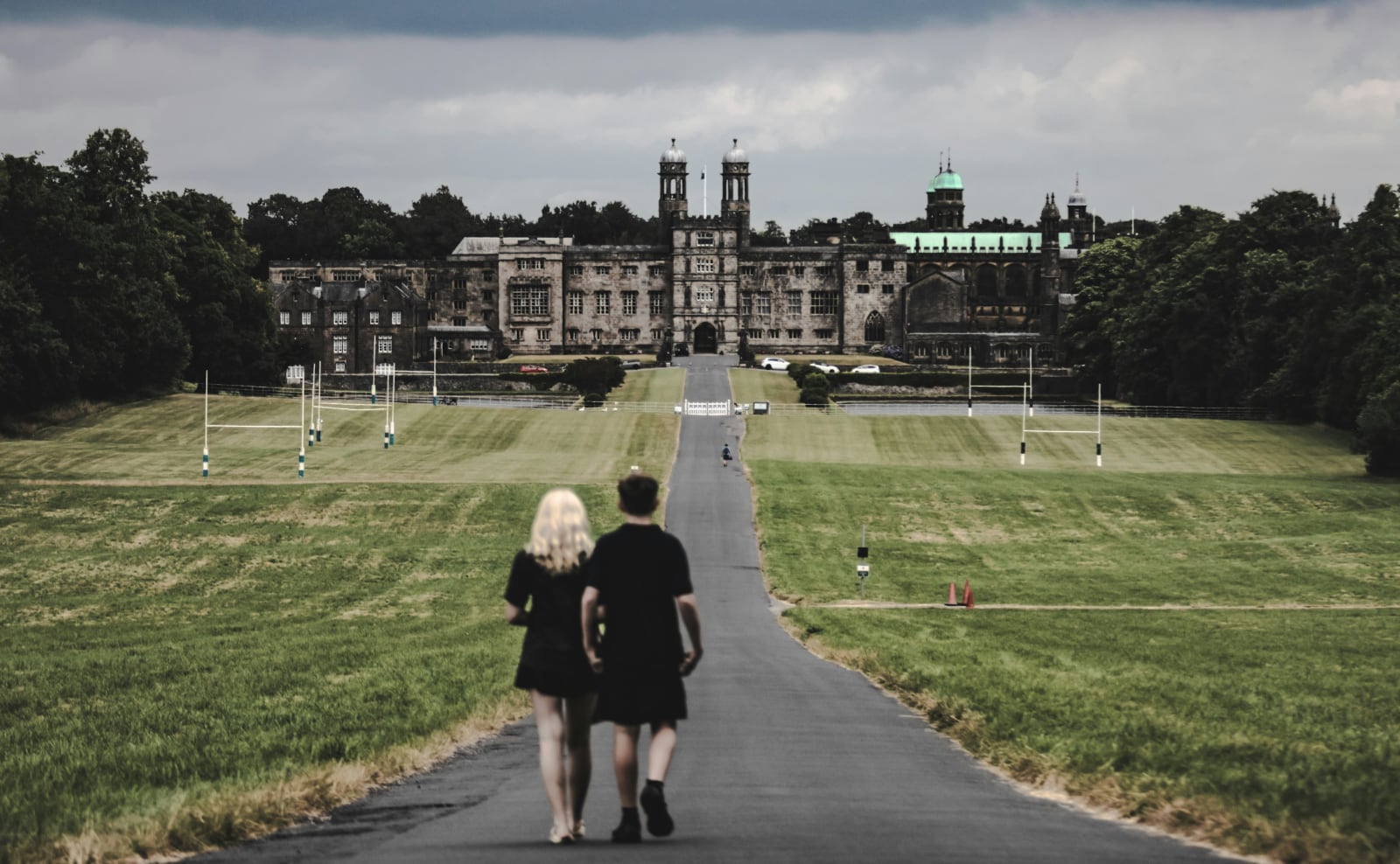
Top image courtesy of Michael Starkie.